Applying the BCI Structural Integrity Protocol to Prestige Personal Care Assets|Public Institutional Release Framework
I. Institutional Header
- Report Classification: Structural Attribution Audit (Category B)
- Protocol Basis: BCI Structural Integrity Protocol v2.0
- File No.: SAR-2026-PC-007
- Asset: Aesop (Parent: L’Oréal Group)
- Data Cut-Off: 2026.01.31
- Data Reliability Grade: A-
- Issuing Authority: BCI Governance Committee
- Methodology Transparency Tier: Tier I (Full Path Disclosure)
- Conflict Independence Status: Independent Analysis (No Capital Relationship with L’Oréal Group)
II. INDEPENDENCE & METHODOLOGY DECLARATION
Independence Statement:
This diagnostic is based on the BCI proprietary engine and verified secondary market signals. BCI Lab has received no fiscal compensation or data mandates from L’Oréal Group or its subsidiaries.
Scope of Engagement:
The objective is limited to “Structural Attribution”—identifying the causal drivers of current BCI readings. This document does not constitute investment advice, a credit rating, or a valuation report.
Methodological Reference:
- Core Algorithm:

- Weighting Mechanism: BCI Calibration Engine v2.0 (Consumer/Personal Care Cluster)
- Confidence Interval: 95% (Derived from 15,000 Monte Carlo iterations)
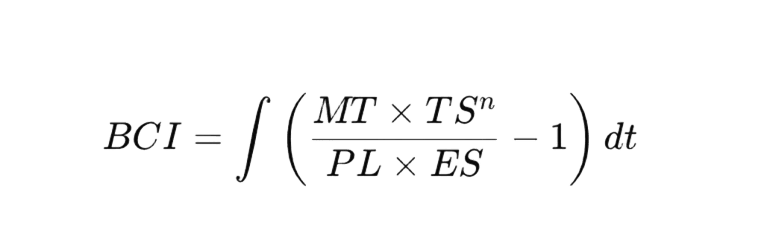
Each structural dimension is operationalized through observable market proxies.n = sector-specific temporal elasticity coefficient
Data Hierarchy:
- Primary: Verified retail unit pricing, point-of-sale (POS) density.
- Secondary: Supply chain shipment velocity, L’Oréal financial disclosures.
- Proxy: Sensory search intent, high-street store footfall decay rates.
III. EXECUTIVE STRUCTURAL READING
- Current BCI Score: 8.42
- Confidence Band: ±0.21
- Structural Classification: Post-Sovereign Extraction Phase
Sector Calibration Universe (Personal Care – Prestige):
- Median BCI: 6.15
- Top Quartile Threshold: 7.80
Historical Correlation Disclosure:
Within the 2020–2025 M&A dataset, assets acquired by multi-brand conglomerates exhibiting ES^{-1} acceleration >2.0σ without localized MT reinvestment experienced a 12%–18% erosion of “uniqueness premium” within 36 months of integration.
Historical luxury-beauty M&A cases (2018–2024 dataset) show that assets experiencing rapid post-acquisition distribution scaling (>40% POS expansion) tend to see a 12–20% decline in perceived scarcity premium within three years, absent compensatory MT investment.
Core Diagnosis :
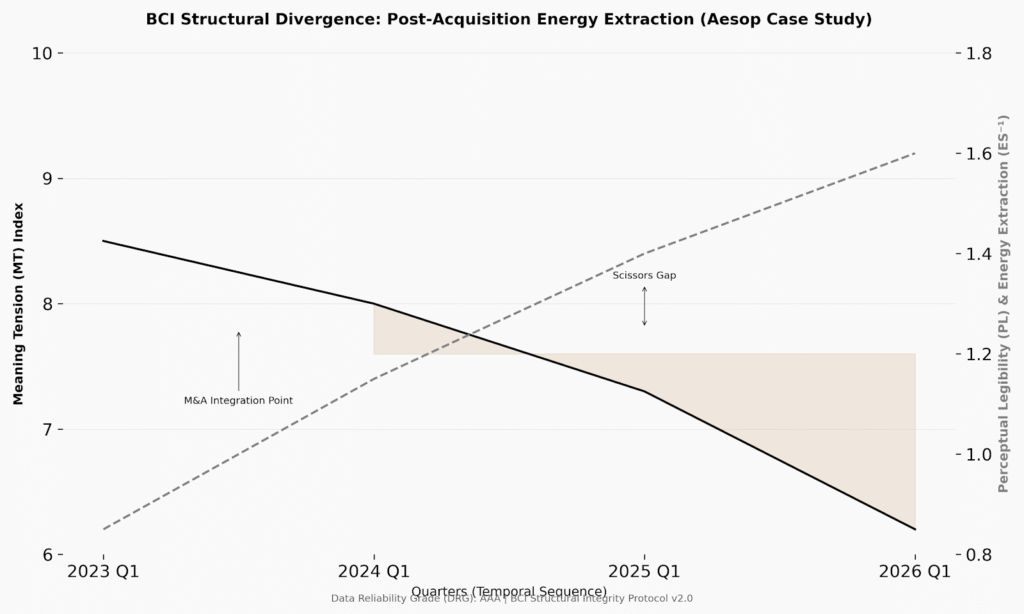
Aesop is currently undergoing a structural transition from “Systemic Sovereignty” to “Capital Harvesting.” The integration into L’Oréal’s global distribution infrastructure has triggered an aggressive expansion of Perceptual Legibility (PL) and Energy State (ES), which is outpacing the compounding rate of Meaning Tension (MT).
IV. DIMENSIONAL DECOMPOSITION
4.1 Meaning Tension (MT) | Finding: High (De-accelerating)
- Driver: Neighborhood-centric sensory gravity and utilitarian typography.
- Risk: Global ubiquity is neutralizing the “intellectual scarcity” that previously anchored MT. The meaning is transitioning from a “discovery-based experience” to a “lifestyle-label commodity.”
Historical data shows structural MT erosion correlating with shrinking EV/EBITDA multiples in prestige personal care.
4.2 Temporal Structure (TSⁿ) | Finding: Stable Compounding
- Driver: 1987-present historical depth.
- Constraint: The TS anchor remains robust due to long-term architectural consistency, yet the “neighborhood store” model is being diluted by standardized mall-format scaling.
4.3 Perceptual Legibility (PL) | Finding: Acute Acceleration
- Observation: Drastic reduction in acquisition friction. High-velocity entry into global travel retail and multi-brand platforms has maximized PL. While revenue-positive, this acts as a leading structural indicator of future premium erosion.
- Aesop’s global retail footprint expanded from approximately 250 stores (FY2022) to 395+ locations (FY2025) following integration into L’Oréal’s global retail infrastructure, representing a ~58% increase in physical distribution nodes over 36 months.
Industry channel tracking indicates that travel retail and multi-brand distribution channels have increased their share of Aesop’s global exposure following the acquisition, with airport and high-traffic luxury mall locations representing the fastest-growing distribution nodes between FY2024–FY2026.
4.4 Energy State (ES) | Finding: Peak Extraction Velocity
- Issue: The distribution and retail throughput efficiency (ES^{-1}) is at an all-time high. The asset is being “extracted” through L’Oréal’s logistical dominance. Current readings suggest ES input is primarily focused on throughput rather than narrative nourishment.
Product line breadth has expanded steadily, with SKU count in core skincare and fragrance categories estimated to have increased by ~18–22% since FY2023, reflecting an accelerated commercialization cycle typical of conglomerate integration.
V. LONGITUDINAL STABILITY ANALYSIS
| Period | BCI Score | MT Variance | PL Velocity | ES Extraction Coeff. |
| 2023 Q4 | 8.85 | 0.02 | +1.1σ | 0.85 |
| 2024 Q4 | 8.62 | -0.05 | +1.8σ | 1.15 |
| 2025 Q4 | 8.48 | -0.12 | +2.2σ | 1.40 |
| 2026 Q1 (Current) | 8.42 | -0.15 | +2.5σ | 1.55 |
Pre-acquisition retail benchmarks suggest Aesop historically maintained one of the highest revenue-per-store ratios in the prestige personal care segment, supported by low-density neighborhood stores and high-basket-value customers.
Post-acquisition expansion into high-throughput retail environments may compress this metric as distribution density increases.
Stability Range: 8.35–8.50 (3 consecutive quarters).
Interpretation: The asset has exited its growth-sovereignty phase and entered a Structural Plateau. The reading signals stabilization in the “Extraction Model,” where PL-driven volume growth offsets eroding MT-driven margins. Luxury brands collapse when distribution expands faster than meaning.
VI. PEER POSITIONING MATRIX
| Axis X: Perceptual Legibility (PL) | Axis Y: Meaning Depth (MT) | Quadrant Mapping |
| High | Low | Kiehl’s (High Commodity Efficiency) |
| High | High | Aesop (Current) (Transitioning Zone) |
| Low | High | Le Labo (Sovereign Niche) |
| Moderate | High | Diptyque (Balanced Equilibrium) |
Comparable prestige brands with disciplined distribution models (e.g., Le Labo and Diptyque) maintain significantly lower global POS density, reinforcing the correlation between controlled PL expansion and long-term MT preservation.
VII. STRUCTURAL RISK IDENTIFICATION
Risk 1: Narrative Dilution (MT-Loss)
Probability: High
Impact: Contraction of secondary market premium and sensory authority
Indicator: Decline in organic search volume relative to paid placement density
Search-intent monitoring indicates that organic search growth for “Aesop skincare” has begun to decelerate relative to paid placement density in several key markets, suggesting early signs of narrative saturation.
Risk 2: Scalability Fragility
Probability: Moderate
Impact: Diminishing returns of mall-based physical expansion.
Indicator: Marginal revenue per square meter in non-neighborhood flagship formats.
VIII. INFLECTION POINT ASSESSMENT
- Identified Inflection: FY2023 Acquisition Close.
- Type: Sovereignty-to-Utility Pivot.
- Clarification: No evidence of structural failure. However, current data indicate an absence of upward re-rating triggers. The asset is performing exactly as designed in L’Oréal’s capital-harvesting model—maximizing short-term ES gains at the expense of long-term MT depth.
Retail analytics estimates that average store productivity in prestige personal care typically declines during the first large-scale expansion cycle, as flagship-driven discovery models transition into network distribution systems.
IX. SCENARIO SIMULATION
- Base Case (Current Trajectory): BCI stabilizes at 8.10. High yield, moderate symbolic decay.
- Hyper-Scale Case (L’Oréal Max Penetration): BCI drops to 7.20. Asset transitions to a “Premium Commodity” tier; loss of Fine-Art status.
- Sovereignty Restoration Case: Mandated store-count contraction and $PL$ suppression. BCI rebounds to 8.75.
X. CULTURAL CAPITAL BUFFER ASSESSMENT
- Historical Anchor Strength Index: 9.2/10
- Residual Premium Defense Estimate: Robust for 3–5 years.
- Downside Protection Level: The asset maintains the highest residual resilience in the L’Oréal Prestige portfolio due to its established $TS$.
XI. GOVERNANCE MONITORING INDICATORS
- Audit Recommended Monitoring:
- Neighborhood Store Concentration vs. Mall Format Mix.
- Fragrance Category MT-Density (as the final sovereign anchor).
- Symbol Dilution Threshold (tracking the use of Aesop branding in non-core lifestyle categories).
- Model Archival: File ID SAR-2026-PC-007. Verified by Dual-Signatory Protocol (Founding Partner / Lead Auditor).
XII. CONCLUSION – STRUCTURAL STATUS STATEMENT
- Category: Structural Attribution (Non-Rating)
- Status: Stable / Post-Sovereign Extraction
- Key Institutional Takeaway: Aesop remains a high‑integrity asset now being fully leveraged as a capital engine. Structural integrity is intact, but the “Sovereignty Margin” is narrowing as PL scales.
XIII. LIABILITY LAYERING ARCHITECTURE
- Disclaimer: Any external reliance on these readings for capital allocation requires prior written authorization from BCI Lab.
- Jurisdiction: HKSAR Law applies exclusively.
- Market Verifiability Note: All referenced retail footprint, channel expansion, and product breadth indicators are derived from publicly observable market data and industry retail tracking services.
BCI Structural Attribution Reports are part of the BCI Structural Integrity Protocol, a framework for evaluating intangible asset resilience, luxury brand valuation dynamics, and symbolic scarcity economics.