BCI Report

A centralized archive of BCI structural audits assessing governance stability, symbolic compounding, and systemic risk across intangible and brand-based assets.

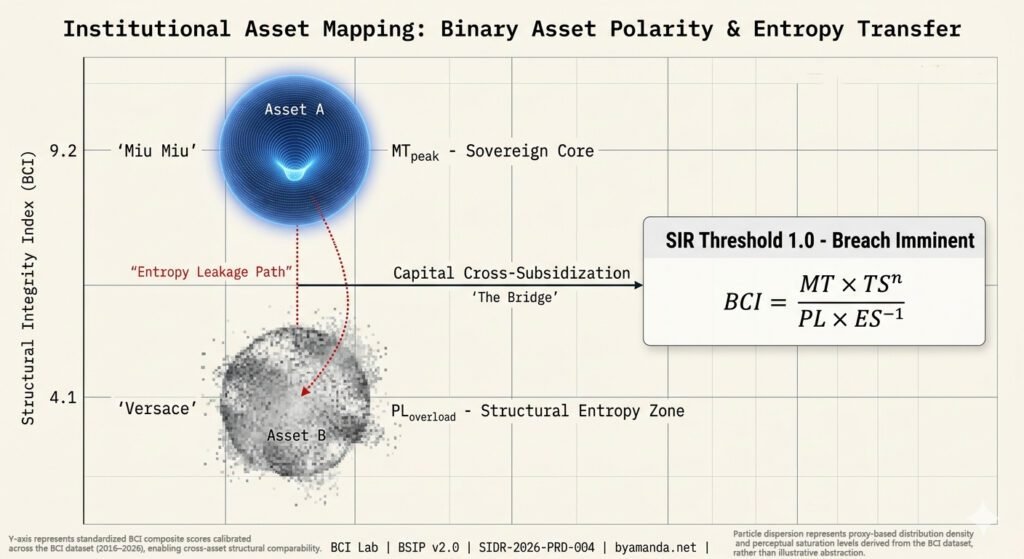
BCI  Lab  Structural Integrity Review – Prada Group (Category C )

  Institutional Header   Report Classification: Category C | Structural Integrity & M&A Risk Audit   Report ID: SIDR-2026-PRD-004   Data Cut-Off Date: 2026-03-22   Model Version: BSIP v2.0 Sentimental Asset Logic   Data Reliability Grade (DRG): Tier-1 (Consolidated Group Financials & Greater China Retail Distribution Mapping)   Research Domain: Intangible Asset Valuation & Premium […]

BCI  Lab  Structural Integrity Review – Prada Group (Category C ) Read More »
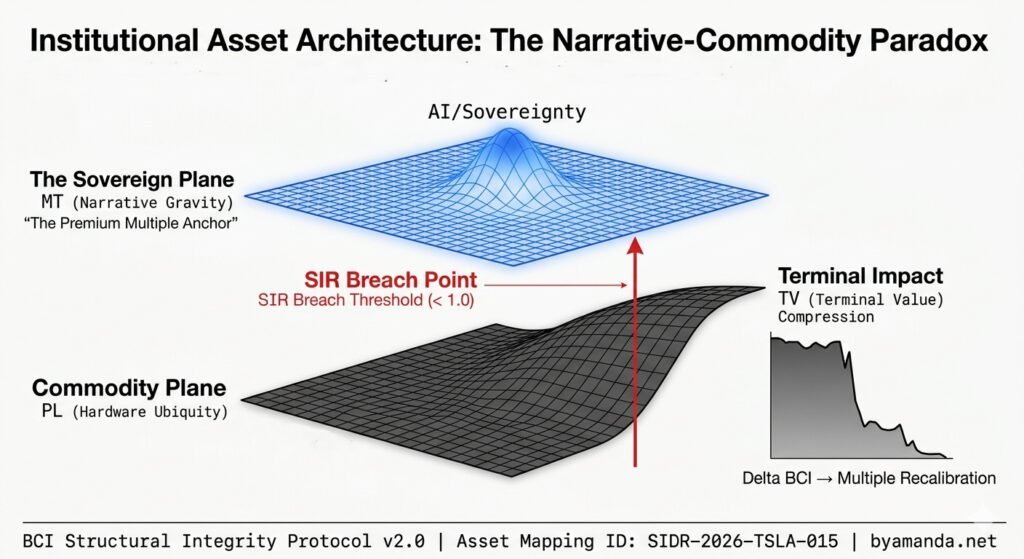
BCI Lab institutional diagnostic chart mapping Tesla's structural risk. The visualization models the conflict between high-tension Narrative Gravity (MT) and rising Hardware Ubiquity (PL). It identifies the 'Sovereignty Breach Threshold' where the Symbolic Insulation Ratio (SIR) drops to 0.65, signaling that the asset's visual scarcity is neutralized. This structural entropy leads to a causal chain of WACC drift and Terminal Value (TV) compression. The chart proves that unless a 'Structural Pivot' to AI-sovereignty is realized before the BDI expiry, the current growth multiple faces a high-convexity recalibration toward industrial-benchmark levels

BCI  Lab  Structural Integrity Review – Tesla (Category C )

  I. Institutional Header     II. Executive Summary: Structural Status Reading The Phenomenon: Tesla, Inc. has entered a phase of intense distribution saturation in the China market, characterized by aggressive recalibrations of pricing and an aging product portfolio (Model 3/Y). While volume remains historically high, the asset is transitioning from “Technological Sovereign” to “Industrial

BCI  Lab  Structural Integrity Review – Tesla (Category C ) Read More »

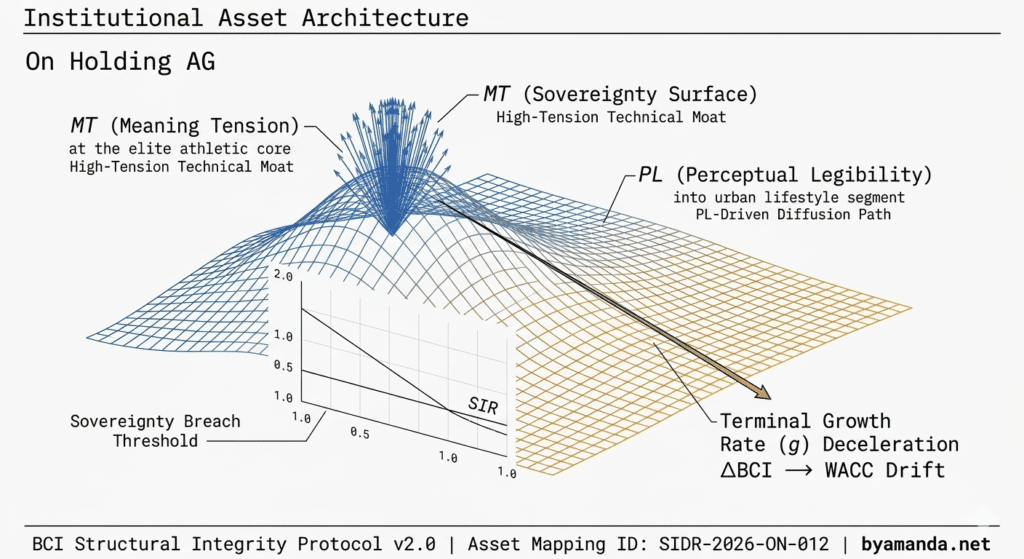
BCI  Lab  Structural Integrity Review – On Holding AG (Category B)

I. Institutional Header     II. Executive Summary: Structural Status Reading The Phenomenon: On Holding recently surpassed CHF 3 billion in net sales for FY2025, primarily driven by accelerated wholesale penetration and DTC expansion across APAC markets. Despite posting record gross margins, early signs of valuation compression and multiple recalibration have already surfaced in secondary

BCI  Lab  Structural Integrity Review – On Holding AG (Category B) Read More »

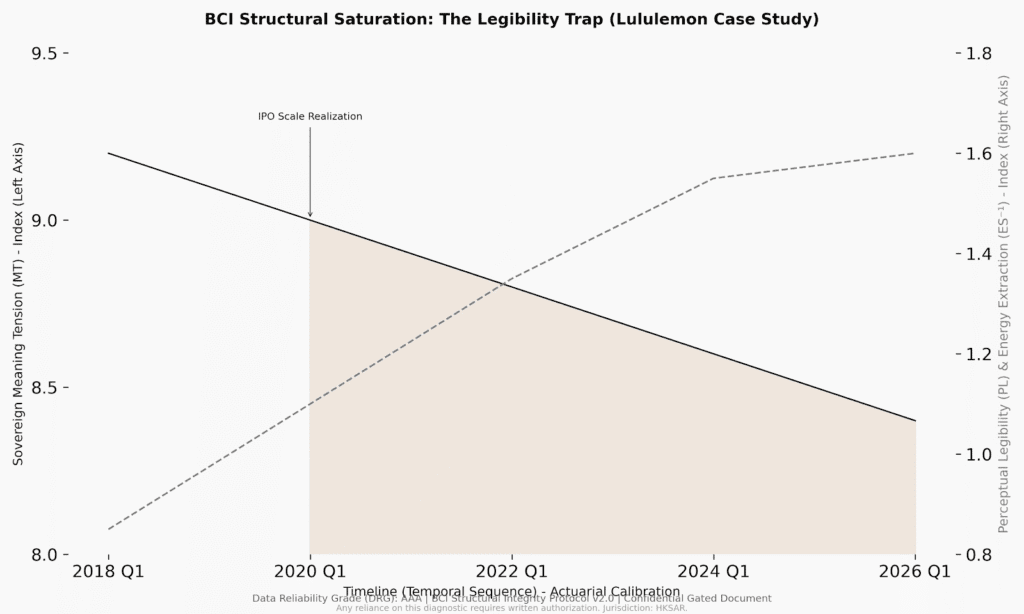
BCI Lab Structural Integrity Diagnostic Chart for Lululemon (NASDAQ: LULU). The visualization quantifies the 'Terminal Perceptual Saturation' effect, mapping the critical divergence between maximized Perceptual Legibility (PL) and eroding Meaning Tension (MT). It identifies the Sovereignty Erosion Zone where high distribution density liquidates pricing power, providing a lead indicator for valuation multiple compression and transition from a sovereign community brand to a global consumer utility asset.

BCI Structural Integrity Review –Lululemon (Category B)

Public Institutional Release Framework (Structural Attribution Audit)     Cover Page     Independence & Methodology Declaration Independence Statement This report is using the proprietary analytical framework developed by BCI Lab, which is based exclusively on publicly available financial disclosures from Lululemon Athletica Inc., including SEC filings, together with third-party retail channel monitoring data.  

BCI Structural Integrity Review –Lululemon (Category B) Read More »

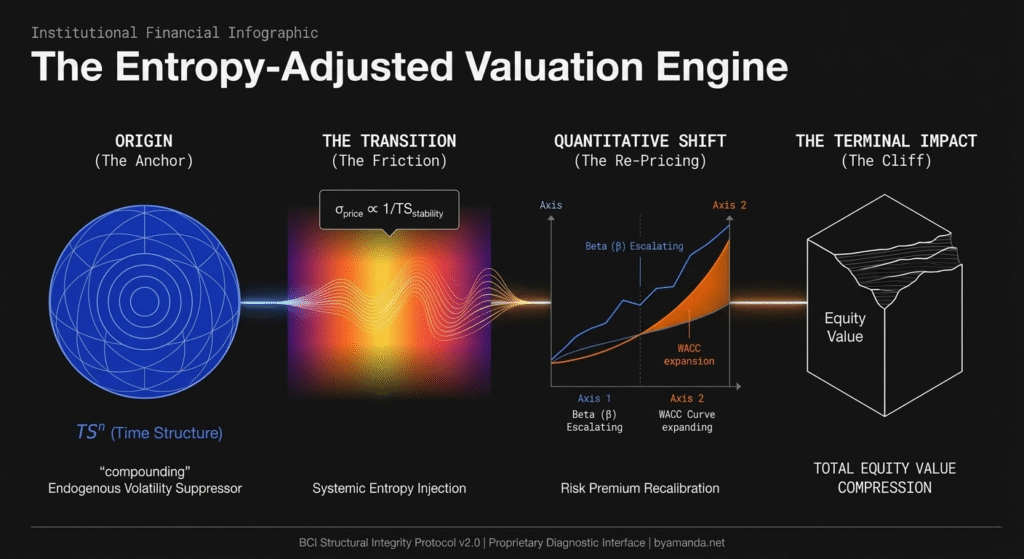
A financial infographic mapping the BCI Structural Integrity Protocol v2.0 financial transmission mechanism. It illustrates how the degradation of endogenous volatility suppressors—specifically the Time Structure ($TS^n$)—leads to a causal chain resulting in terminal value compression. The four-stage process shows: 1. The Origin of Time Structure as an endogenous volatility dampener; 2. The Transition through Systemic Entropy Injection, modeled by the relationship $\sigma_{price} \propto 1/TS_{stability}$; 3. The Quantitative Shift where Beta ($\beta$) escalates and WACC (Weighted Average Cost of Capital) drifts upward; and 4. The Terminal Impact, showing high-convexity compression of the Total Equity Value multiple. The infographic concludes that capital mispricing happens at underwriting due to unmodeled structural entropy detected long before a Goodwill Impairment trigger. Footered for byamanda.net.

 BCI  Lab  Structural Integrity Review – Alo Yoga (Category B)

    I. Institutional Header     II. Executive Summary: Structural Status Reading   The Phenomenon: The target asset is initiating physical retail expansion within core Chinese commercial districts (e.g., Sanlitun, Jing’an Kerry Centre). However, before the establishment of official physical interfaces, the asset’s symbolic system had already undergone profound regional diffusion driven by an

 BCI  Lab  Structural Integrity Review – Alo Yoga (Category B) Read More »

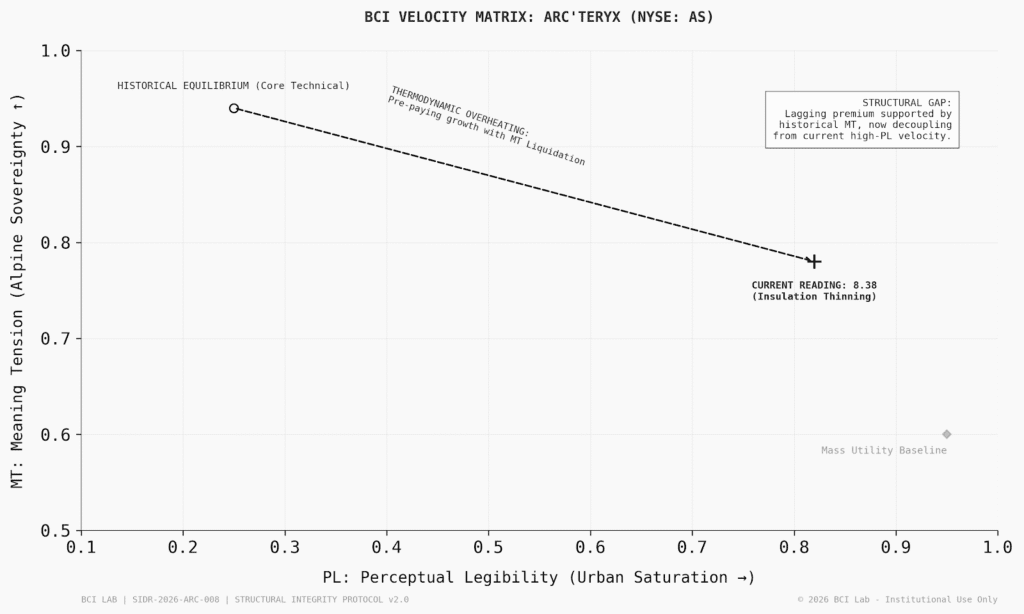
BCI Lab Structural Integrity Diagnostic Chart for Arc'teryx (Amer Sports). The visualization quantifies the 'Thermodynamic Overheating' effect, mapping the divergence between Alpine Meaning Tension (MT) and Urban Perceptual Legibility (PL). It identifies the Scaling Friction Gap where rapid distribution expansion threatens the technical premium insulation of the brand equity, providing a leading indicator for margin ceiling and symbolic commoditization.

BCI Structural Integrity Review –Arc’teryx (Category B)

    Public Institutional Release Framework (Structural Attribution Audit)     Cover Page Report Classification: Structural Attribution Audit (Category B)   Independence & Methodology Declaration Independence Statement This report uses the proprietary BCI analytical framework. It draws on publicly disclosed information from Amer Sports, cross-verified with secondary market observations and supply-chain data signals. BCI has

BCI Structural Integrity Review –Arc’teryx (Category B) Read More »

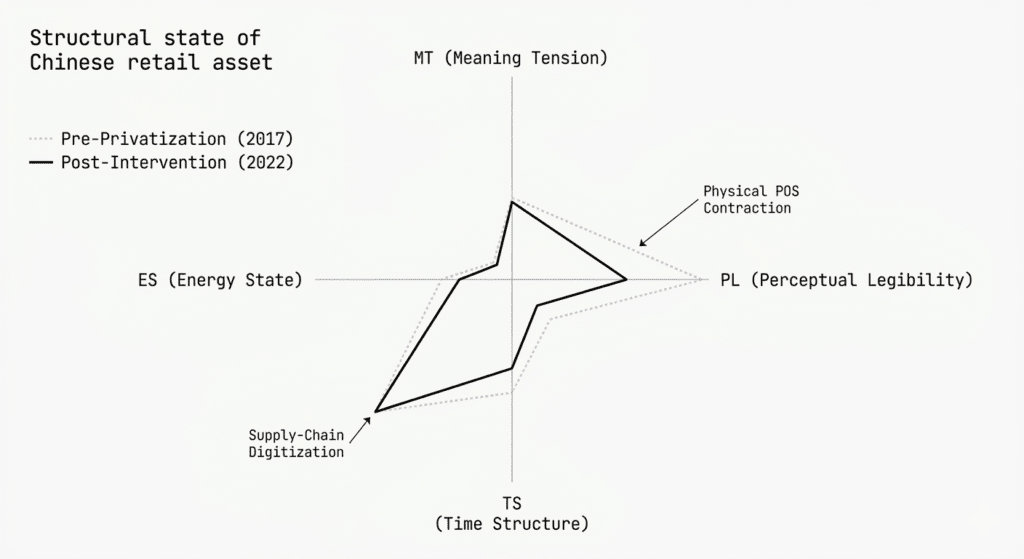
BCI Lab Institutional Radar Chart: Structural Attribution Audit of Belle International. The diagnostic maps the 'Pre-Privatization' vs 'Post-Intervention' structural states, quantifying the Hillhouse Capital turnaround. Metrics visualize a severe contraction in physical Perceptual Legibility (PL) and optimized internal Energy State (ES), resulting in the stabilization of Meaning Tension (MT) against shifting Chinese consumer digital behaviors

Belle International Turnaround: A Structural Diagnostic of the Hillhouse Capital Intervention

Institutional Attribution Audit of Digital Transformation and Capital Restructuring in Chinese Consumer Markets   Executive Summary BCI Status: Sovereignty Restoration Phase   Core Diagnosis: Private equity intervention successfully re-engineered Perceptual Legibility (PL) from physical over-saturation to digital precision, simultaneously lowering Energy State (ES) extraction velocity and stabilizing Meaning Tension (MT) against the shifting consumption patterns

Belle International Turnaround: A Structural Diagnostic of the Hillhouse Capital Intervention Read More »

BCI Lab Structural Integrity Audit Chart for Porsche AG (ETR: P911). The graph visualizes the Sovereign Dilution Gap, quantifying the divergence between Meaning Tension (MT) and Perceptual Legibility (PL). It identifies why high-volume SUV scaling acts as a structural drag on Porsche's valuation multiples, contrasting its premium industrial asset structure against the absolute luxury sovereignty of Ferrari (RACE).

BCI  Lab Structural Integrity Review – Porsche (Category B)

  Public Institutional Release Framework (Structural Attribution Audit)   Cover Page   Independence & Methodology Declaration Independence Statement This report is generated using the proprietary BCI analytical framework in conjunction with publicly disclosed market information, including exchange filings and third-party supply chain data sources. BCI Lab has received no financial mandate, internal data access, or

BCI  Lab Structural Integrity Review – Porsche (Category B) Read More »

BCI Lab Institutional Radar Chart: Structural Attribution Audit of L Catterton PE Extraction Model. The visualization maps the 'Sovereign Pre-Acquisition' state vs 'Post-PE Extraction' state, quantifying the structural deformation of intangible assets. Key metrics show a 65% contraction in Meaning Tension (MT) and systemic depletion of Time Structure (TS), contrasted by a terminal expansion in Perceptual Legibility (PL), illustrating the trade-off between short-term capital velocity and long-term asset integrity

L Catterton Portfolio Stress Test| A Structural Diagnostic of PE Asset Extraction

Institutional Attribution Audit of Private Equity Capital Extraction Mechanisms     Executive Summary BCI Status: Extraction Plateau   Core Diagnosis: Private equity optimization within the L Catterton portfolio forces Perceptual Legibility (PL) expansion beyond the inherent Meaning Tension (MT) regeneration capacity of the underlying assets   Capital Market Consequence: Post-exit assets exhibit increased valuation fragility

L Catterton Portfolio Stress Test| A Structural Diagnostic of PE Asset Extraction Read More »

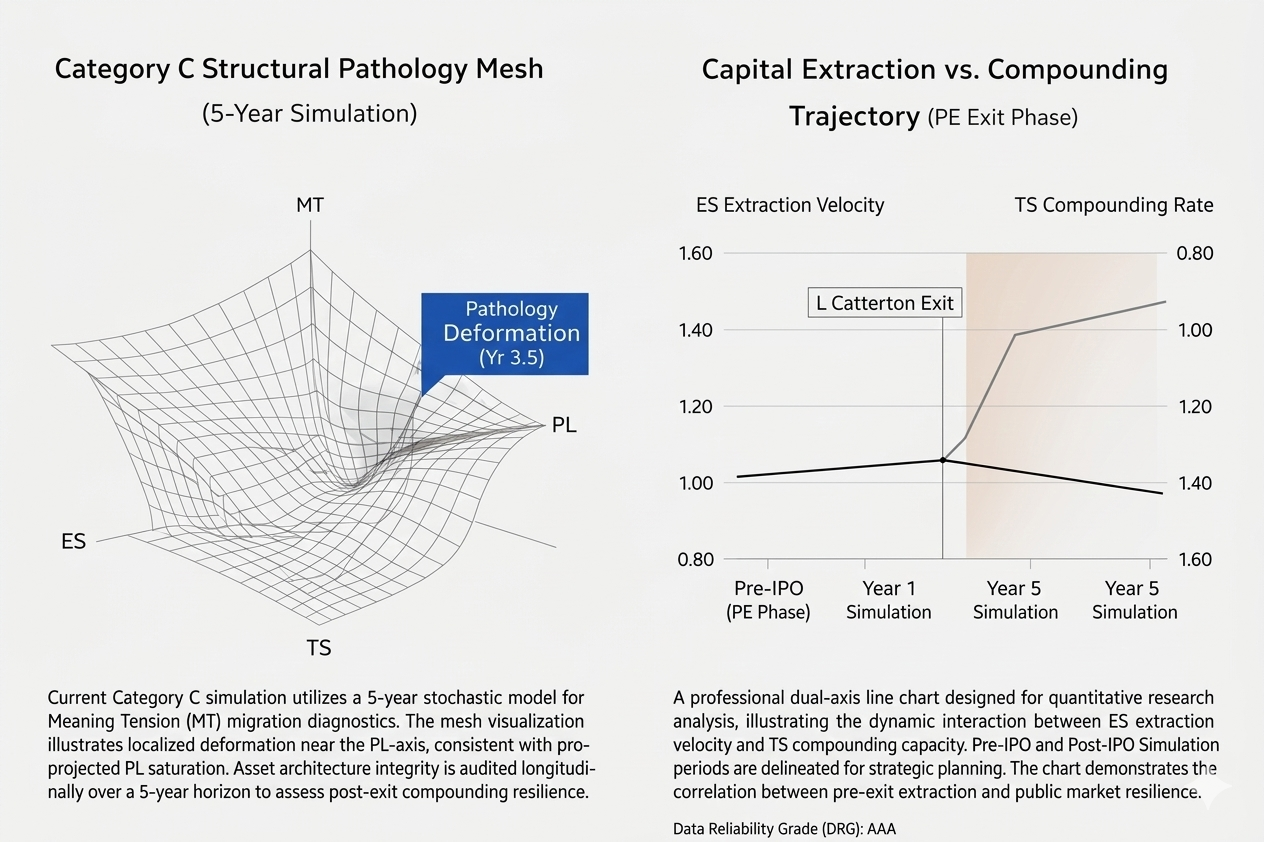
BIRK BCI Structural Mapping Mesh: A 5-year longitudinal simulation of Birkenstock demonstrating high TS axis rigidity and a projected structural deformation near the PL axis, indicating potential post-PE extraction exhaustion.
 Longitudinal Trajectory Chart of Birkenstock (BIRK): Visualizing the inverse correlation between peak Energy State (ES) extraction velocity during the private equity exit phase and the subsequent pressure on Time Structure (TS) compounding capacity in public markets.


Birkenstock Holding plc (BIRK)| IPO Asset Integrity Test & Post-PE Exit Structural Resistance

Category C Structural Integrity Audit: Birkenstock (BIRK) Post-IPO Asset Resistance BIRK Post-IPO Structural Audit | BCI Stress Test     Research Classification BCI Category: Category C — Structural Integrity Report (5-Year Longitudinal Simulation) Research Series: Public Market Pricing Capacity & Intangible Asset Stress Tests Sector: Premium Footwear & Cult-Signifier Assets   Executive Summary This report

Birkenstock Holding plc (BIRK)| IPO Asset Integrity Test & Post-PE Exit Structural Resistance Read More »

Scroll to Top