I. Institutional Header
- Report Classification: Category C | Structural Integrity & M&A Risk Audit
- Report ID: SIDR-2026-CRD-005
- Data Cut-Off Date: 2026-03-23
- Model Version: BSIP v2.0 Sentimental Asset Logic
- Data Reliability Grade (DRG): Tier-1 (Consolidated Group Financials & Travel Retail Distribution Mapping)
- Research Domain: Intangible Asset Valuation & Premium Brand Economics
Dataset Reference:
All BCI readings and derived indicators are calibrated against a standardized dataset covering 30+ global luxury and niche fragrance assets over the 2016–2026 period, incorporating distribution density, pricing dispersion, and secondary market liquidity proxies.
II. Executive Summary: Structural Status Reading
The Phenomenon: Kering Beauté has formally initiated the commercial integration of Creed. The operational objective primarily focuses on maximizing the asset’s near-term cash flow contribution to help offset revenue slowdown across the broader group portfolio. This necessitates a structural pivot for Creed from a restricted allocation model to globalized, multi-channel distribution.
The Latency Gap: There is a pronounced latency between the financial realization of structural entropy and the physical expansion of points of sale. Top-line revenue spikes driven by travel retail and digital distribution expansion mathematically mask the underlying liquidation of symbolic scarcity.
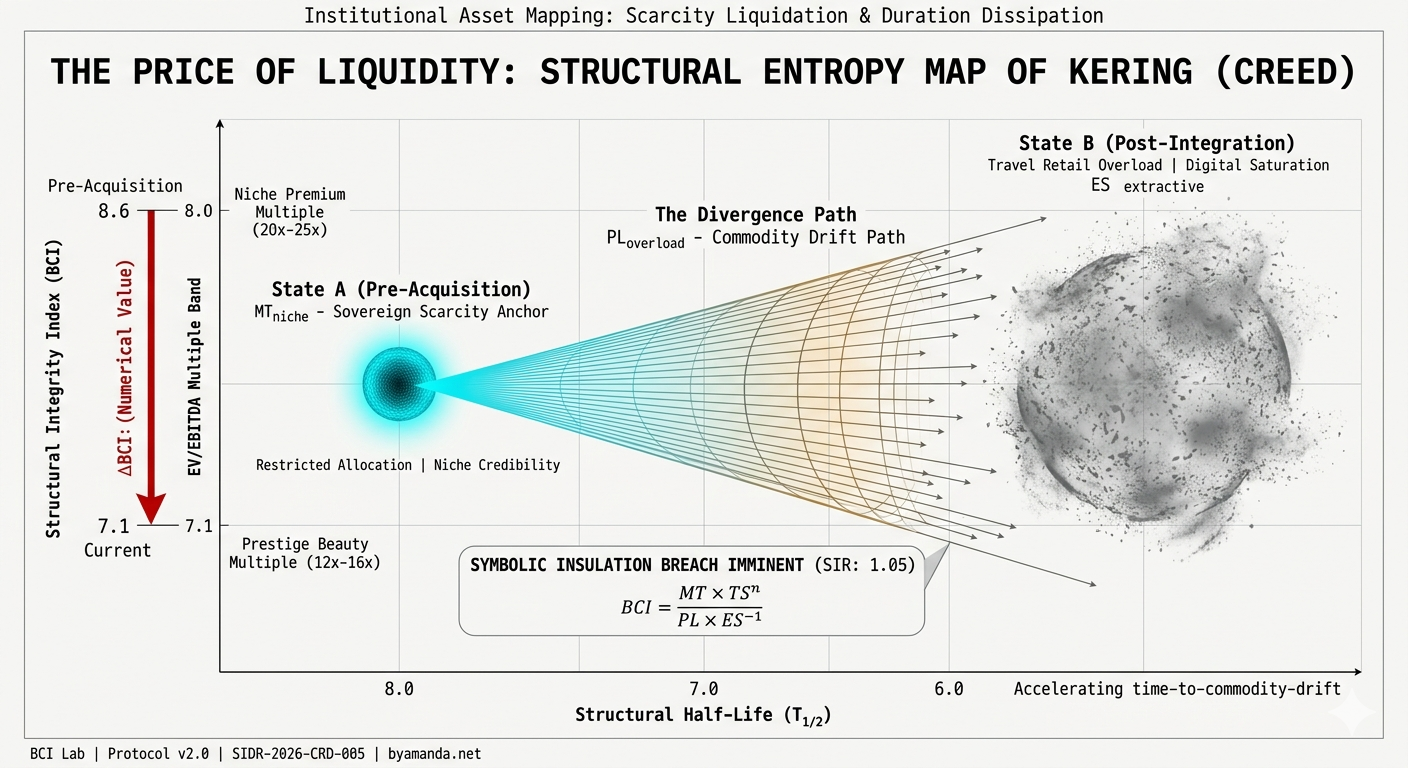
BCI Core Reading: BCI Score: 7.1
Confidence Band: ± 0.28
Momentum Vector: Accelerating Dissipation (Current Slope)
Market Context Anchor: The high-end niche fragrance sector commands extreme valuation multiples based strictly on cognitive distance and controlled accessibility. Imposing industrial retail velocity onto a scarcity-based asset historically triggers an Optimization-Fragility Trade-off.
Canonical Case (BCI Terminology Anchor):
Within the BCI framework, Creed currently represents a canonical case of “Scarcity-to-Liquidity Conversion” — a structural condition in which controlled-access luxury assets are systematically transformed into high-velocity distribution systems. This results in monetizing symbolic scarcity at the cost of long-term structural integrity.
The BCI Dashboard & Historical Trajectory
- BCI Core Derivatives
- BDI (BCI Duration Index): 4.2 Years
- BDV (BCI Dilution Velocity): +0.65_{Quartile} (Indicating aggressive scale-up friction).
- SIR (Symbolic Insulation Ratio): 1.05 (Critically approaching the 1.0 structural vulnerability threshold).
- Historical Trajectory Matrix (Simulated Backtest)
- Q1 2025: 8.6 (Pre-acquisition peak sovereignty).
- Q4 2025: 7.8 (Integration announcement).
- Current: 7.1 (Active distribution expansion).
III. Structural Diagnostics: Variable Decomposition
Observation conducted via the universal engine:

Meaning Tension (MT): Gravity Dilution. The asset’s historical “niche salon” gravity is currently being tested. As the physical and digital distance between the asset and the consumer narrows, the structural tension sustaining hyper-premium pricing power slowly weakens.
Perceptual Legibility (PL): Velocity Overload. The strategic push into duty-free hubs and broad e-commerce ecosystems reduces cognitive friction to near zero. This represents a direct exchange: trading absolute scarcity for maximum legibility.
Observable market signals within the global fragrance distribution system include:
- Accelerated penetration of Creed within high-traffic duty-free hubs (Hainan, Dubai, Incheon), increasing point-of-sale visibility
- Rising price dispersion across cross-border e-commerce and grey-market decant channels
- Increased frequency of promotional bundling and travel-exclusive SKUs is diluting the core product hierarchy
- Convergence in shelf placement alongside prestige beauty brands within travel retail environments
Interpretation:
These signals are structurally consistent with Perceptual Legibility (PL) acceleration through channel expansion, leading to measurable erosion in cognitive scarcity.
Time Structure (TS): Duration Dissipation. The long-tail compounding effect (TS^n) intrinsic to legacy perfumery is being compressed. The operational requirement for immediate quarterly yield overrides the slow-burn validation required for intergenerational asset preservation.
Energy State (ES): Extraction Mode. The systemic relationship has inverted. The infrastructure is no longer operating to nourish the asset; rather, the system is actively extracting stored premium value from the asset to subsidize broader group requirements.
Observable Proxies:
- MT → Decant pricing stability in the secondary market, unauthorized discount frequency.
- PL → Travel retail penetration rate, wholesale partner density.
- TS→ Core heritage SKU reliance vs. frequency of commercial flanker launches.
- ES → Wholesale revenue mix ratio vs. sovereign boutique revenue.
IV. Capital Transmission Map
WACC Sensitivity: The structural conversion of Creed from an inelastic, high-tension luxury asset into a highly legible, fast-moving consumer good introduces structural instability. This inevitably leads to greater cash flow volatility (Beta drift), thereby raising the risk-adjusted cost of capital.
Terminal Value (TV) Sustainability: The liquidation of scarcity (driven by PL overload) guarantees accelerated current-year free cash flow but severely compresses the TS^n compounding rate. This structural entropy systematically degrades the perpetual growth rate (g), leading to unavoidable Terminal Value compression.
Goodwill Risk Layer: The historic multiple paid during the M&A phase established a rigid financial threshold. A breach of the SIR threshold (< 1.0) serves as a quantifiable leading indicator for future Goodwill Impairment, signaling that the residual pricing power can no longer support the capitalized asset value on the balance sheet.
Calibration Note:
In the BCI dataset, assets with SIR < 1.0 have historically been more exposed to pricing volatility and multiple compression, often ahead of impairment testing in post-acquisition integration.
Multiple Stability Interface:
Niche fragrance assets need a BCI above 8.0 to sustain EBITDA multiples above 20x. A sustained structural reading below 7.0 reclassifies the asset into standard prestige beauty multiples, erasing the “scarcity premium” from the valuation model.
Strategic Interpretation :
The system is effectively converting long-duration symbolic scarcity into short-cycle cash flow, indicating that current growth is being financed through the structural depletion of the asset’s premium reserve.
V. Governance Option Descriptions
If management utilizes BCI telemetry, the current entropy velocity is observable and mitigable. We map, you choose:
Scenario A: Maximum Yield Extraction (The Efficiency Path)
Action: Maintain current aggressive expansion velocity across travel retail, broad wholesale, and digital channels to maximize near-term consolidated cash flow.
BCI Trajectory: 7.1 → 5.8 over 18 months.
Counterfactual: Delivers immediate revenue accretion, successfully offsetting external portfolio pressures in the current fiscal year. The corresponding trade-off is irreversible MT dilution and a severe structural downgrade of the asset’s Terminal Value.
Scenario B: Scarcity Insulation (The Sovereignty Path)
Action: Impose strict allocation quotas, freeze unvetted travel retail expansion, and absorb short-term revenue deceleration to protect the asset’s core gravitational field.
BCI Trajectory: 7.1→ 7.9 over 24 months.
Counterfactual: Results in muted near-term cash flow contribution to the parent group. However, this path arrests the dissipation of duration, securing the TS^n compounding necessary to validate and defend the original M&A acquisition multiple in perpetuity.
VI. Institutional Footer: The Liability Layering
- Rating Limitation: This report does not constitute a credit rating, securities analysis, or valuation report. It is a structural diagnostic review intended exclusively for institutional risk governance and capital decision support.
- Reassessment Trigger Statement: Significant shifts in wholesale distribution strategy, major adjustments to pricing architecture, or changes in group capital allocation priorities will immediately trigger a re-audit of these structural readings.
- Jurisdictional Limitation: This report and its interpretive frameworks are governed solely by the legal framework of the Hong Kong Special Administrative Region.
- Research Independence Statement: BCI Lab operates with absolute autonomy and does not accept commissioned analytical mandates for structural diagnostics.