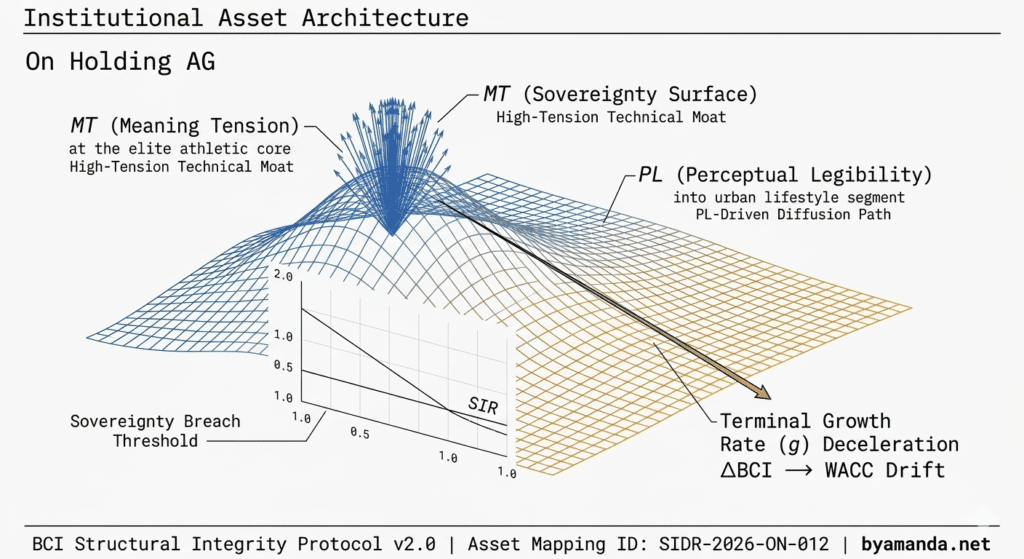
I. Institutional Header
- Report Classification: Category B | Structural Attribution Report
- Report ID: SIDR-2026-ON-012
- Asset Subject: On Holding AG (China Market & Global Terminal Value Risk)
- Data Cut-Off Date: 2026-03-15
- Model Version: BSIP v2.0 Sentimental Asset Logic
- Data Reliability Grade (DRG): Tier-1 (Audited FY2025 Financials & Global POS Density Proxies)
- Research Domain: Intangible Asset Valuation & Premium Brand Economics
II. Executive Summary: Structural Status Reading
The Phenomenon: On Holding recently surpassed CHF 3 billion in net sales for FY2025, primarily driven by accelerated wholesale penetration and DTC expansion across APAC markets. Despite posting record gross margins, early signs of valuation compression and multiple recalibration have already surfaced in secondary capital markets following the recent earnings release.
The Latency Gap: Current financial statements capture the massive revenue pulse generated by maximum distribution throughput and mass commuter adoption. Due to the inherent latency of traditional accounting standards, the balance sheet fails to immediately capture the structural overdraft of the asset’s underlying cognitive sovereignty—specifically, the transition from specialized Swiss-engineered performance gear to a ubiquitous urban uniform.
Within the BCI framework, cognitive sovereignty refers to an intangible asset’s ability to maintain its symbolic scarcity and narrative authority, even as distribution density and market visibility increase.
Assuming management possessed current BCI readings, the structural entropy acceleration preceding this ubiquity could have been fundamentally subject to capital intervention.
On Holding exemplifies the Performance-to-Uniform Drift—a structural condition in which the symbolism of performance transforms into urban uniformity through excessive distribution and scaling.
- BCI Core Reading:
- BCI Score: 5.4
- Confidence Band: ± 0.18
- Momentum Vector: Downward Slope
- Market Context Anchor: Premium athleisure brands have experienced accelerated valuation expansion following the post-pandemic consumer shift toward performance lifestyle products. However, the Optimization-Fragility Trade-off dictates that scaling physical availability inherently introduces cognitive friction.
Institutional Observation:
Within the BCI structural dataset, assets undergoing rapid distribution scaling without proportional reinforcement of Meaning Tension (MT) historically transition from performance-specialist positioning toward mass lifestyle uniformity. This transition often precedes a measurable decline in symbolic insulation and valuation of multiple resilience.
The BCI Dashboard & Historical Trajectory
1. BCI Core Derivatives
- BDI (BCI Duration Index): 1.8 Years.
- BDV (BCI Dilution Velocity): +0.65/{Quartile}.
- SIR (Symbolic Insulation Ratio): 0.82. A reading of SIR < 1 indicates the asset’s symbolic gravity is increasingly insufficient to insulate against cognitive friction, pushing it toward the Commodity Drift threshold.
- Structural Half-Life (t_{1/2}): Estimated at 2.6 years, representing the projected time required for the asset’s premium symbolic power to decay by half under the current dilution velocity (BDV) trajectory.
2. Historical Trajectory Matrix (Simulated Backtest)
| Quarter | Q1 2025 | Q2 2025 | Q3 2025 | Q4 2025 | Current (Q1 2026) |
| BCI Reading | 6.8 | 6.4 | 6.1 | 5.8 | 5.4 |
| Status Phase | Equilibrium | Vulnerability | Vulnerability | Dissipation | Dissipation |
III. Structural Diagnostics: Variable Decomposition
Systemic observation executed via the BCI Structural Integrity Equation:

Observable Proxies:
- MT→ Core runner adoption rates vs. mass-market commuter volume; secondary market premium retention.
- PL → Wholesale door count velocity; high-street visual density of the CloudTec sole.
- TS → Average active SKU lifespan; frequency of colorway-driven revenue drops.
- ES → Revenue per square meter in newly opened APAC flagship locations.
IV. Capital Transmission Map
WACC Sensitivity: The transition from a specialized performance moat to a mass-lifestyle utility exposes the target asset to fashion-cycle volatility. As the Symbolic Insulation Ratio (SIR) drops below 1.0, defensive pricing power erodes. This instability in operating leverage inherently elevates beta volatility, forcing a structural upward drift in the WACC.
Within the BCI calibration universe (2016–2025 premium sportswear dataset), assets entering prolonged PL saturation phases without corresponding MT reinforcement exhibited measurable increases in capital sensitivity to distribution slowdown and consumer sentiment volatility.
Terminal Value (TV) Sustainability: The degradation of TS^n directly compresses the duration of the asset’s premium pricing power. In DCF modeling, the assumption of perpetual high-growth Terminal Value is invalidated; the t_{1/2} (Structural Half-Life) dictates a forced deceleration in the terminal growth rate (g) to reflect impending commodity drift.
Goodwill Risk Layer: For public market valuations, the current high-growth P/E multiples (historically >50x) are sustained by the linear extrapolation of the initial distribution-expansion phase. As structural entropy accumulates via PL overload, the probability of crossing a multiple-recalibration threshold increases, functioning as a preemptive indicator of intangible asset impairment long before traditional financial covenant triggers.
Multiple Stability Interface:
Assets with a BCI above 8.0 have historically exhibited stable premium multiples, driven by sustained MT and TS compounding. With a current reading of 5.4, the asset now sits within the Vulnerability Zone, indicating that its valuation multiples are highly sensitive to any slowdown in PL expansion or changes in broader consumer sentiment.
V. Governance Option Descriptions
We map the following capital consideration paths based on BCI structural dynamics (We map, you choose):
Scenario A: The Scale Extraction Path
Structural Path Description: Maintain the current trajectory of aggressive wholesale penetration and rapid regional retail rollout to maximize short-term cash flow and capture the remaining lifestyle market share.
BCI Trajectory: 5.4 → 4.5 over 24 months.
Capital Consideration: Capitalizes on immediate ES efficiency but accelerates Duration Dissipation. The asset effectively acknowledges its transition into a mass-market commodity, undergoing a fundamental downgrade in valuation multiples to align with traditional, mature sportswear peers.
Scenario B: The Sovereign Contraction Path
Structural Path Description: A strategic contraction in wholesale distribution combined with performance-focused retail environments would historically correlate with MT stabilization.
BCI Trajectory: 5.4 → 6.8 over 24 months.
Capital Consideration: Absorbs a short-term deceleration in top-line revenue growth to stabilize the Symbolic Insulation Ratio (SIR), thereby defending the long-term Terminal Value and insulating the premium multiple structure.
VI. Institutional Footer
Rating Limitation: BCI readings and associated derivative metrics provided in this report function exclusively as physical mapping tools for asset structural integrity. They do not constitute credit ratings, security analysis, or corporate valuation directives.
Reassessment Trigger Statement: Should the target asset execute material structural adjustments to its wholesale distribution ratios, initiate large-scale category pivots (e.g., mass apparel scaling), or experience macro-level supply chain fractures, the current slope and terminal forecasts herein are immediately invalidated.
Jurisdictional Limitation: The interpretative authority of this report and its derivative data is governed by the legal framework of the Hong Kong Special Administrative Region.
Research Independence Statement: BCI Lab operates independently and does not accept commissioned analytical mandates for structural diagnostics. This report is the natural output of internal monitoring protocols.
Citation Policy: Academic citation, institutional reference, and analytical discussion of this report are permitted provided that attribution to BCI Lab and the BCI Structural Integrity Framework is clearly maintained.