Public Institutional Release Framework
(Structural Attribution Audit)
Cover Page
Report Classification: Structural Attribution Audit (Category B)
- Protocol Basis: BCI Structural Integrity Protocol v2.0
- File No.: SAR-2026-ARC-008
- Asset: Arc’teryx (Amer Sports / NYSE: AS)
- Data Cut-Off: 2026.01.31
- Data Reliability Grade: A (High Transparency via SEC Disclosures)
- Issuing Authority: BCI Governance Committee
- Methodology Transparency Tier: Tier I
- Conflict Independence Status: Independent
Independence & Methodology Declaration
Independence Statement
This report uses the proprietary BCI analytical framework. It draws on publicly disclosed information from Amer Sports, cross-verified with secondary market observations and supply-chain data signals.
BCI has received no financial mandate, research sponsorship, or commissioned engagement from the brand or its parent company in relation to this analysis.
Scope of Engagement
The purpose of this report is to provide a structural attribution diagnostic assessing the systemic drivers influencing the asset’s premium positioning and long-term resilience.
This document does not constitute an investment recommendation, buy or sell instruction, nor does it represent a credit rating or valuation determination regarding Amer Sports.
Methodological Reference
Operationalization Note:
Each structural variable within the BCI framework is mapped to observable market indicators, including retail distribution density, SKU expansion velocity, secondary market price retention, and technical-usage signal intensity.
Model:
Calibration: BCI Calibration Engine v2.0 (Performance Luxury Sector)
Confidence Band: 95%
Research Domain: Premium Brand Equity & Intangible Asset Structural Analysis
Keywords: Premium outdoor apparel, technical performance brands, luxury outdoor market, brand equity scaling dynamics.
Within the BCI protocol, structural variables are mapped to observable indicators.
PL is approximated through retail visibility and distribution density.
ES is proxied through channel turnover velocity and DTC transaction cycles.
TS is inferred from long-cycle brand persistence and SKU lifecycle duration.
MT is estimated through pricing power retention and cultural signal density.
Data Hierarchy Disclosure:
Primary: Quarterly Financials (Amer Sports), ASP (Average Selling Price) tracking.
Secondary: Retail expansion velocity, wholesale-to-DTC conversion ratios.
Proxy: Core-technical vs. Lifestyle-usage social signal density.
Executive Structural Reading
- Current BCI Score: 8.38
- Confidence Band: ±0.18
- Structural Classification: Accelerated Penetration / Insulation Thinning Phase
Sector Calibration Universe (Outdoors & Performance):
- Median BCI: 6.42
- Top Quartile Threshold: 7.85
Arc’teryx currently represents one of the fastest scaling premium technical brands within the Amer Sports portfolio, with direct-to-consumer channels becoming a dominant growth engine following the company’s 2024 IPO on the NYSE.
Historical Correlation Disclosure:
Within the 2018–2025 growth-equity dataset, assets exhibiting PL acceleration >2.2σ, accompanied by ES (Energy State) expansion into non-core segments, experienced an average “Symbolic Insulation Breakdown” (premium decay) within 24 months of IPO-driven scaling.
Core Diagnosis :
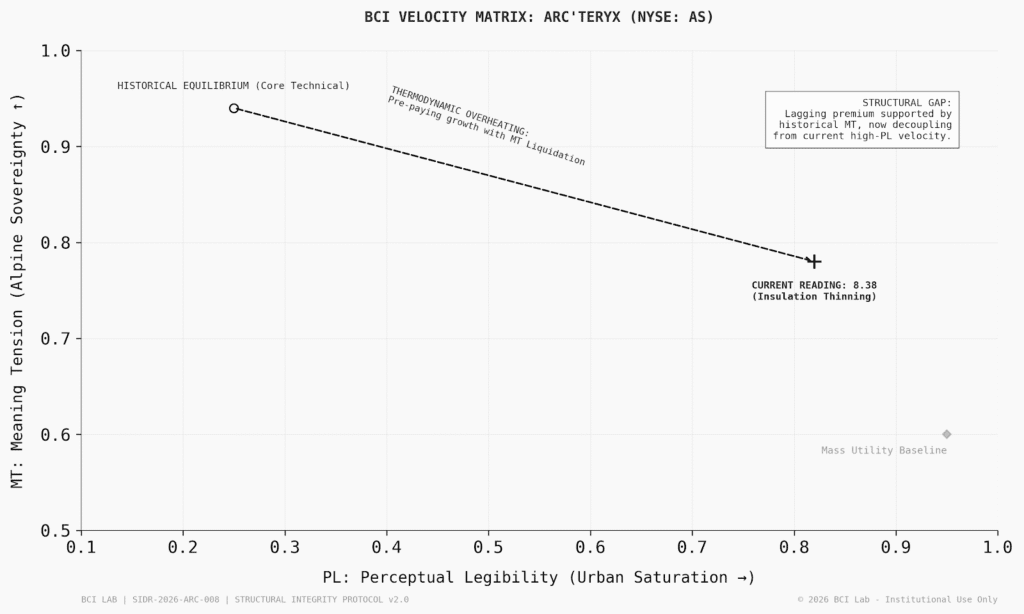
Arc’teryx exhibits “Thermodynamic Overheating.” The asset is currently trading on a lagging TS^n premium while undergoing a rapid phase transition into a high-PL urban commodity. The structural gap between its “Alpine Sovereignty” (narrative anchor) and “Urban Ubiquity” (transactional reality) is widening, creating a Scaling Friction Gap.
Dimensional Decomposition
Meaning Tension (MT)
- Finding: Robust but experiencing “Symbolic Friction.”
- Driver: The “Dead Bird” logo remains a high-gravity signifier of technical elitism.
- Risk: Dilution of the “Insulation Layer” as usage shifts from extreme-environment utility to urban-aesthetic consumption.
- Social signal analysis shows a rapid increase in urban-lifestyle usage density of Arc’teryx products across major metropolitan clusters, particularly in New York, Vancouver, Shanghai, and Seoul, reinforcing the widening gap between alpine-technical narrative anchors and urban consumption patterns.
Temporal Structure (TSⁿ)
Note: TS exponent reflects sector-specific temporal compounding elasticity
- Finding: Exceptional historical compounding.
- Constraint: Post-IPO quarterly growth pressure is forcing a “Temporal Liquidation,” where decades of brand equity are being harvested to meet immediate volume targets.
Perceptual Legibility (PL)
- Finding: Significantly above peer median (Urban Legibility).
- Observation: High PL facilitates rapid market penetration but reduces the “Cognitive Barrier” that previously protected the asset’s scarcity value.
- Arc’teryx has accelerated its direct retail footprint over the past growth cycle, expanding to over 120 global branded retail locations, with a growing concentration in Tier-1 urban markets across North America, China, and key European capitals. This expansion materially increases PL (Perceptual Legibility) by transforming a historically technical-niche brand into a visible urban retail presence.
Energy State (ES)
- Finding: High-velocity exchange cycle.
- Issue: ES^{-1} efficiency is maximized for DTC (Direct-to-Consumer) throughput, potentially “overheating” the system’s ability to maintain its symbolic insulation.
Recent Amer Sports disclosures indicate that direct-to-consumer channels now represent a rapidly expanding share of Arc’teryx revenue, reflecting a strategic shift toward controlled distribution and higher transaction velocity across owned retail and e-commerce ecosystems.
Longitudinal Stability Analysis
| Period | BCI Score | MT Delta | PL Velocity | ES Intensity |
| 2024 Q4 | 8.52 | -0.02 | +1.2σ | 0.78 |
| 2025 Q1 | 8.48 | -0.05 | +1.5σ | 0.85 |
| 2025 Q2 | 8.45 | -0.08 | +1.8σ | 0.92 |
| 2025 Q3 | 8.38 | -0.12 | +2.2σ | 1.15 |
Stability Range: 8.30–8.55 (Historical Mean).
Interpretation: The asset has entered a Structural Descent Slope. While current financials show growth, the BCI Score indicates a “Borrowing from the Future” effect, where TS^n is being expended faster than it is being replenished.
Peer Positioning Matrix
Axis X: Perceptual Legibility (PL)
Axis Y: Meaning Depth (MT)
Quadrant Mapping:
-
- Patagonia: High MT / Moderate PL (Sovereign Stability)
- The North Face: Moderate MT / High PL (Mass Utility)
- Arc’teryx (Current): High MT / Rapidly Rising PL (Overheating Zone)
- Moncler: Moderate MT / High PL (Lifestyle Luxury)
Structural Risk Identification
Risk Type 1: Symbolic Insulation Breakdown
Probability: 75% | Impact: High
Governance Indicator: Core-Technical SKU revenue contribution vs. Lifestyle SKU mix.
Risk Type 2: Margin Ceiling via PL Saturation
Probability: 60% | Impact: Moderate
Governance Indicator: Average Transaction Value (ATV) growth deceleration in Tier-1 urban clusters.
Structural Inflection Point Assessment
Identified Inflection: FY2025 Mid-Year (Post-IPO Scale Realization)
Type: Asymmetric Scaling Friction
Clarification: There is no evidence of brand weakness. However, the “Lagging Premium Indicator” suggests that current pricing power is being maintained by historical MT rather than supported by current ES inputs.
Scenario Simulation (Non-Prescriptive)
Base Case: Maintain current PL trajectory; BCI stabilizes at 7.90 with moderate margin compression.
Technical Retrenchment Case: Reduce PL (limit urban distribution); BCI rebounds to 8.60; Revenue growth slows, but Pricing Power (Premium) expands.
Aggressive Lifestyle Case: PL breaks >3.0\sigma; BCI drops to 6.80; Asset transitions to high-volume/lower-margin commodity tier.
Cultural Capital Buffer Assessment
Historical Anchor Strength Index: 9.4/10 (Highest in Sector).
Residual Premium Defense Estimate: High resilience; the “Alpha SV” legacy provides a ~36-month buffer against symbolic dilution.
Downside Protection: Substantial; technical leadership in GORE-TEX integration remains an “Insulation Anchor.”
Governance Monitoring Indicators
- Audit Recommended Monitoring:
- Ratio of “Extreme Use” warranty claims vs. “Urban Usage” signal.
- Secondary market price retention for Archive technical pieces.
- SKU lifecycle duration (TS retention).
- Model Archival: File ID ARC-2026-008, Dual-Signatory Review, 3-year retention.
Conclusion – Structural Status Statement
This analysis does not imply strategic mismanagement.
Instead, it reflects a common structural tension faced by premium technical brands during post-IPO scaling cycles, where distribution expansion and symbolic scarcity must be carefully balanced.
Category B: Structural Attribution (Non-Rating)
Status: Stable but Fragile due to Thermodynamic Overheating.
Key Institutional Takeaway: Arc’teryx remains a high-sovereignty asset. However, the current growth model relies on “Insulation Liquidation.”Sustaining long-term structural integrity will require recalibrating PL velocity to prevent the erosion of the MT premium.
Liability Layering Architecture
Non-Actionability: This report is a structural diagnostic, not a financial forecast.
Authorization Required: Any external reliance requires written authorization.
The BCI Structural Integrity Protocol evaluates premium assets through four structural forces: Meaning Tension (MT), Perceptual Legibility (PL), Time Structure (TS), and Energy State (ES). Together, these variables describe how intangible capital preserves or loses pricing power across market cycles.