Institutional Attribution Audit of Digital Transformation and Capital Restructuring in Chinese Consumer Markets
Executive Summary
BCI Status: Sovereignty Restoration Phase
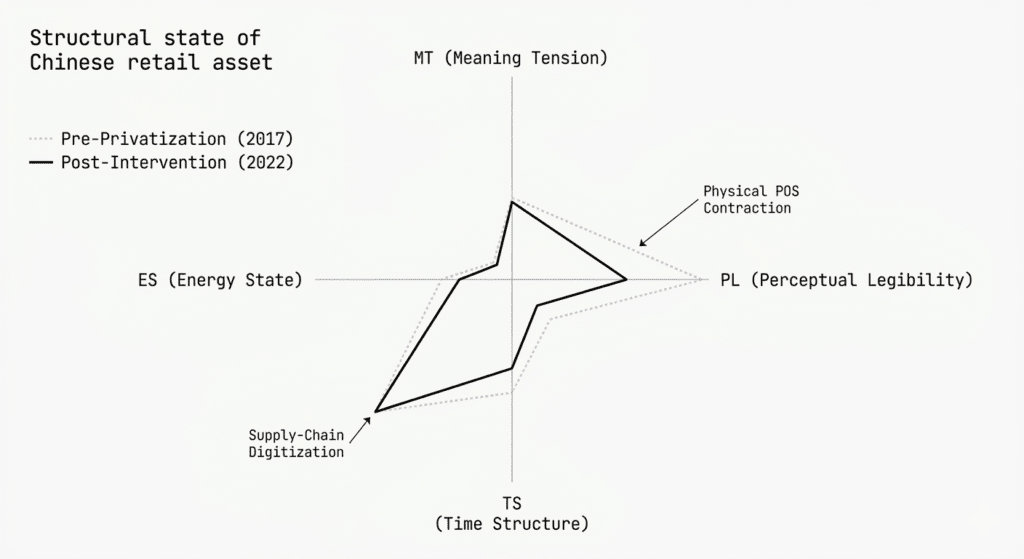
Core Diagnosis: Private equity intervention successfully re-engineered Perceptual Legibility (PL) from physical over-saturation to digital precision, simultaneously lowering Energy State (ES) extraction velocity and stabilizing Meaning Tension (MT) against the shifting consumption patterns of the Chinese market.
Capital Market Consequence: Privatization-driven operational restructuring creates a “capital dark room” that shields legacy assets from the earnings pressure of public markets. This enables the systemic repair of structural integrity, facilitating subsequent value realization through segmented re-listing (e.g., the 2019 Topsports spin-off and the Belle Fashion IPO filings).
During the privatization phase, Belle International underwent one of the largest retail restructurings in Chinese consumer history, including the closure of over 4,000 underperforming stores and the integration of digital inventory systems across tens of thousands of frontline retail operators. (Sources: HKEX filings; Bloomberg reporting on the Hillhouse-led privatization and subsequent Topsports spin-off considerations; industry restructuring analyses of Belle International’s post-privatization retail network rationalization.)
Governance Implication: For legacy retail assets, physical scale constitutes a structural liability unless governed by supply-chain digitization. Turnaround mandates must prioritize internal data architecture over superficial brand marketing to convert offline footprints into omnichannel assets.
Research Classification
- BCI Category: Category B — Structural Attribution
- Research Series: Private Equity Asset Integrity & Turnaround Mechanics
- Sector: Chinese Consumer Retail & Apparel
- Data Reliability Grade (DRG): AAA (Derived from HKEX public filings and verified market data)
Research Domain
This analysis contributes to understanding the resilience of intangible assets in consumer markets by examining the interplay among private equity governance, retail digital transformation, and long-cycle brand capital formation in China.
Structural Model
The BCI Structural Integrity Equation
The structural trajectory of Belle International is mapped using the proprietary BCI protocol, quantifying the asset’s capacity to absorb market shifts and compound capital:

Within the BCI protocol, structural variables are mapped to observable market indicators.
PL is proxied through distribution density and digital accessibility metrics.
ES is reflected in the circulation of supply-chain data and the velocity of inventory turnover.
TS corresponds to brand longevity and market share persistence across cycles.
MT is approximated through pricing power retention and consumer cultural affinity signals.
BCI Scorecard (Pre vs. Post Hillhouse Intervention)
| BCI Variable | Status Reading (Pre-2017) | Status Reading (Post-2022) | Structural Proxy |
| MT (Meaning Tension) | Severely Diluted | Stabilized Equilibrium | Chinese Consumer Brand Affinity vs. E-commerce Alternatives |
| PL (Perceptual Legibility) | Physical Over-Saturation | Omnichannel Precision | Offline POS Density vs. Online Revenue Contribution (<7% to >28%) |
| TS (Time Structure) | Stagnant Heritage | Activated Foundation | Historical Market Share Compounding |
| ES (Energy State) | High Systemic Dissipation | Optimized Circulation | Inventory Turnover Velocity & Supply Chain Digitization |
Narrative Context: The Chinese Consumer Interface
Before 2017, Belle International operated as the infrastructural footwear provider for the Chinese consumer. Its structural dominance was achieved through sheer physical ubiquity within the traditional department store matrix.
However, as Chinese consumers shifted from utility-driven offline purchasing to digitally integrated experiential consumption, Belle’s primary asset—its extensive physical network—turned into a structural liability.
The system exhibited 13 consecutive quarters of negative same-store sales growth, a leading indicator of MT erosion masked by hyper-saturated physical PL.
The 2017 HK53.1 billion privatization led by Hillhouse Capital represents a definitive case of structural engineering. Recognizing the asset’s “defensive ignorance” regarding digital infrastructure, the intervention bypassed superficial marketing.
Instead, it re-architected the underlying data flow, integrating fragmented offline/online inventories and transforming tens of thousands of frontline retail personnel into decentralized digital touchpoints. This realignment calibrated the asset’s internal physics to match the contemporary Chinese market’s velocity.
This report does not evaluate the normative superiority of any particular capital ownership model.
Instead, the BCI framework analyzes how different governance regimes interact with the structural variables of intangible assets.
In the Belle case, privatization temporarily removed public market pressure, allowing the underlying system to recalibrate its internal energy state and distribution logic.
Diagnostic Blocks
Diagnostic Block 1 — MT Arbitrage & Re-Anchoring
Pre-privatization, the brand portfolio suffered from narrative aging, losing resonance with younger Chinese demographics against agile e-commerce competitors. The turnaround strategy involved segmenting the portfolio and empowering frontline staff as micro-influencers. This localized digital engagement re-anchored MT without relying on mass-market advertising, effectively shifting the brand relationship from transactional utility to continuous digital engagement.
Diagnostic Block 2 — PL Spatial Rationalization
The most visible structural shift occurred along the PL axis. Management executed a severe contraction of inefficient physical distribution nodes (closing over 4,000 underperforming stores) while simultaneously expanding digital legibility. This forced a transition from “blind physical saturation” to “algorithmic precision.” The reduction of physical friction, paired with the integration of 3D foot-scanning technologies, shifted the PL composition from purely transactional to partially experiential.
Diagnostic Block 3 — TS Temporal Utilization
Belle’s three decades of operational history within the Chinese market provided a critical structural buffer (TS). This temporal depth granted the asset systemic resilience, allowing it to withstand the initial shock of the e-commerce transition. The governance committee leveraged its historical supply-chain strengths as the foundation for the digital transformation, demonstrating that TS can serve as a defensive moat during times of structural volatility.
Diagnostic Block 4 — ES Internal Circulation Optimization
Before 2017, the core failure mode was a highly dissipative Energy State (ES). Fragmented data silos across regions, stores, and supply chains created significant inventory friction and capital drag. Hillhouse’s intervention deployed more than 120 technology operators to unify the data architecture. By synchronizing macro‑trend insights with localized frontline inventory, the system dramatically reduced its extraction coefficient (ES⁻¹), restoring the corporate structure to a state of internal nourishment and higher operating margins.
Capital Market Interface
- Implication for M&A Pricing: The Belle case establishes that legacy consumer assets possessing high TS but degraded ES due to technological lag represent optimal privatization targets. Acquirers are essentially purchasing structural optionality at a discount to intrinsic physical scale.
- Implication for Equity Valuation: Successful structural turnarounds alter the valuation paradigm. Post-intervention assets exhibiting high digital PL integration and optimized ES command structurally higher EV/EBITDA multiples upon re-listing, as demonstrated by the Topsports (sportswear division) spin-off.
- Implication for Asset Allocation: Allocators analyzing the Chinese consumer sector must differentiate between brands suffering from terminal MT collapse and those experiencing temporary ES friction. The former is a value trap; the latter presents a high-probability arbitrage opportunity if governance rights are secured.
The Belle restructuring illustrates a recurring pattern in legacy consumer sectors: assets with deep temporal structure (TS) but technologically inefficient energy states (ES) often trade at substantial valuation discounts before
privatization.
Operational restructuring can convert this inefficiency into structural arbitrage once the asset is removed from quarterly earnings pressure.
Strategic Pathways
For Secondary Market Operators: Structural audits must prioritize supply-chain digitization metrics over top-line store count. Physical expansion without data integration mathematically increases systemic fragility.
For Buyout Governance Committees: Turnaround protocols for legacy retail necessitate the complete integration of online and offline inventory states. Frontline personnel must be structurally re-classified from static sales vectors to dynamic digital nodes.
Methodology & Liability
Methodology Reference
This report is produced using the BCI Structural Integrity Protocol v2.0, a proprietary diagnostic framework developed by BCI Lab to measure the structural stability of intangible brand assets across market cycles.
Liability Layering (Status Statement)
- Category B Diagnostic: This document is classified as a “Structural Attribution” review. It does not constitute investment advice, a credit rating, or a valuation report.
- Reassessment Trigger: Reassessment is automatically triggered by material deviations in supply chain integration metrics or structural alterations to the controlling syndicate.
- Jurisdictional Limitation: This diagnostic and its interpretations are strictly subject to the laws of the HKSAR.
BCI Structural Integrity Protocol is a diagnostic framework designed to evaluate the resilience of intangible premium assets through four structural variables: Meaning Tension (MT), Perceptual Legibility (PL), Time Structure (TS), and Energy State (ES).
Research Field
Brand Capital Physics / Intangible Asset Structural Analysis
Knowledge Anchors
- BCI Structural Integrity Protocol
- Brand Capital Integrity (BCI Score)
- Meaning Tension (MT)
- Perceptual Legibility (PL)
- Time Structure (TS)
- Energy State (ES)
- Private Equity Turnaround Mechanics
- Chinese Consumer Retail Digitization
- Intangible Asset Structural Diagnostics