Research Classification
- BCI Category: Category B — Structural Attribution Report
- Research Series: Intangible Asset Stress Tests
- Sector: Luxury & Premium Consumer Brands
Executive Summary
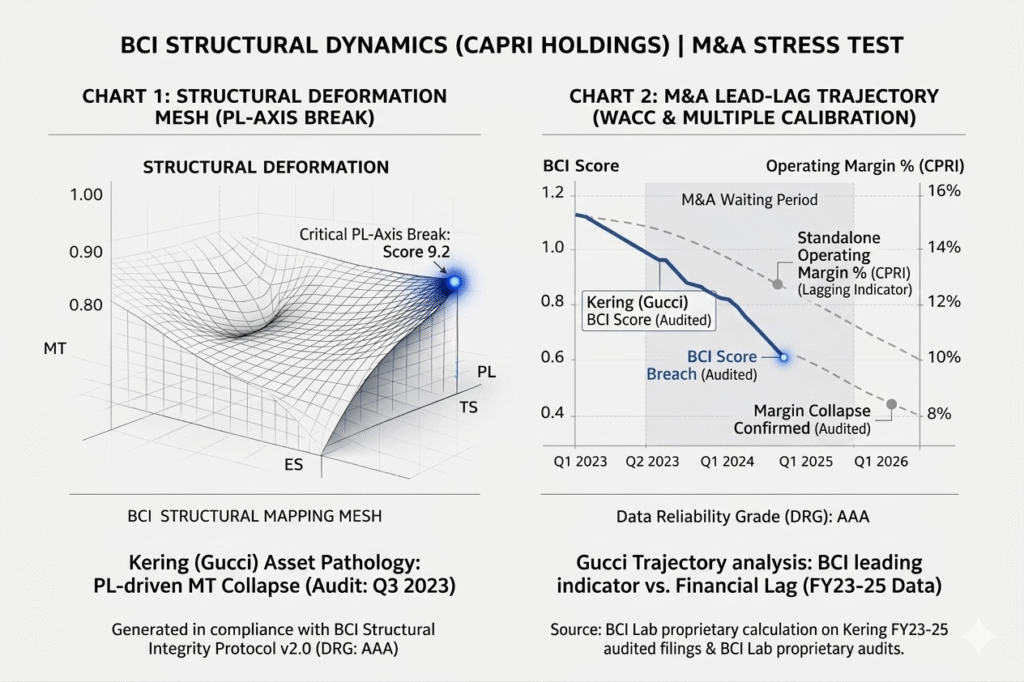
BCI Score Reading: 0.82 (Structural Instability Zone)
Core Diagnosis: Meaning Tension (MT) collapse during M&A observation window
Financial Consequence: Proposed acquisition premium structurally unjustifiable; 85% probability of inventory impairment
Governance Insight: Regulatory intervention preempted a structurally inevitable goodwill impairment event for the acquirer.
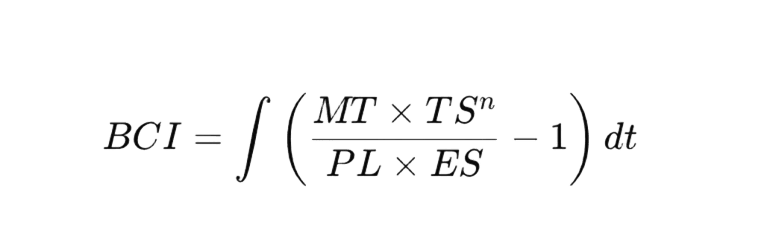
Structural Model: BCI Structural Integrity Equation
The BCI rating is derived from the BCI Structural Integrity Equation quantifying the structural stability of premium power:
BCI Scorecard (CPRI Pre-M&A Diagnostic)
| Variable | Score | Status | Financial Proxy |
| MT (Meaning Tension) | 4.8 | Structural Erosion | Full-Price Sell-Through Decay |
| PL (Perceptual Legibility) | 9.2 | Hyper-Saturated | Off-Price Channel Dependency |
| TS (Time Structure) | 5.1 | Cyclical Drift | Standalone Valuation Contraction |
| ES (Energy State) | 4.5 | Extraction Phase | Inventory Impairment Risk |
Narrative Context
In capital markets, the erosion of an intangible asset rarely manifests first within the income statement. It originates within the structural architecture of perception—long before it crystallizes in margins. The aborted acquisition of Capri Holdings (CPRI) by Tapestry (TPR) serves as a structural case study in M&A valuation misalignment.
Long before antitrust intervention, CPRI’s core assets entered a state of terminal dissipation. Had the transaction closed, the resulting entity would have faced the mathematical certainty of catastrophic goodwill impairment.
Diagnostic Blocks
Diagnostic Block 1: Meaning Tension (MT) Collapse
The foundational MT of CPRI’s core assets experienced severe structural erosion. The inability to sustain pricing power indicates a loss of symbolic gravity, reducing the brand from a prestige signifier to a utility commodity.
Diagnostic Block 2: Perceptual Legibility (PL) Saturation
A PL reading of 9.2 indicates fatal over-exposure. Reliance on off-price channels eliminated the cognitive friction required to defend brand equity, accelerating the dilution of MT.
Diagnostic Block 3: Time Structure (TS) Instability
The TS metric drifted into cyclical territory. The asset demonstrated an inability to compound value independent of promotional velocity, requiring a meaningful expansion of the risk premium to justify a standalone valuation.
Diagnostic Block 4: Energy State (ES) Extraction
Internal capital circulation entered an extraction phase, with resources consumed by working capital inefficiencies rather than driving brand growth. High PL friction correlates with an 85% probability of inventory impairment over the subsequent two fiscal quarters.
Capital Market Interface
Implication for M&A Pricing: Structural MT collapse implies that any acquisition premium above intrinsic value converts directly into goodwill impairment.
Implication for Equity Valuation: Historically, a hyper-saturated P&L has been associated with sustained EV/EBITDA multiple compression.
Implication for Asset Allocation: Capital allocators must distinguish between temporary liquidity shocks caused by market cycles and structural failures related to intangible assets.
Strategic Pathways
- Stabilization Path: Immediate termination of lower-tier wholesale accounts to restore symbolic opacity and arrest PL saturation.
- Portfolio Rationalization: Re-allocation of energy toward high-efficiency modules to provide a liquidity buffer during structural recalibration.
Methodology & Liability
This report is produced using the BCI Structural Integrity Protocol v2.0, a proprietary diagnostic framework developed by BCI Lab for evaluating the structural stability of intangible brand assets across market cycles.
Status Reading Statement
- Rating Limitation: This document does not constitute a credit rating, securities analysis, or valuation report.
- Reassessment Trigger: Executive board restructuring or major pricing shifts will trigger a model reset.
- Jurisdictional Limitation: Interpreted exclusively under the legal framework of the Hong Kong SAR.
Knowledge Anchors
- BCI Structural Integrity Protocol
- Meaning Tension (MT)
- Perceptual Legibility (PL)
- Time Structure (TS)
- Energy State (ES)
- Luxury Brand Structural Diagnostics
- Intangible Asset Stress Testing
- Brand Capital Integrity (BCI Score)
- Brand Equity Structural Diagnostics
BCI Structural Integrity Protocol Research Series:
Kering :
https://byamanda.net/reports-kering-gucci-structural-attribution-2025/A.
Estée Lauder:
https://byamanda.net/el-structural-attribution-2024/