Document Category: Public Methodology / Capital Market Infrastructure
Protocol Alignment: BSIP v3.0
Maintained by: BCI Governance Committee | BCI Lab
There is a rating agency for the debt of a Fortune 500 company. There is no rating agency for the most valuable thing many of those companies own: the meaning attached to their name.
Brand value currently gets priced the way assets were priced before anyone built an instrument for it — backed into as a residual, plugged into a balance sheet as “goodwill,” argued over by bankers who all agree it’s real and disagree by billions on what it’s worth.
BCI exists to replace the argument with a measurement.
The Two Forces
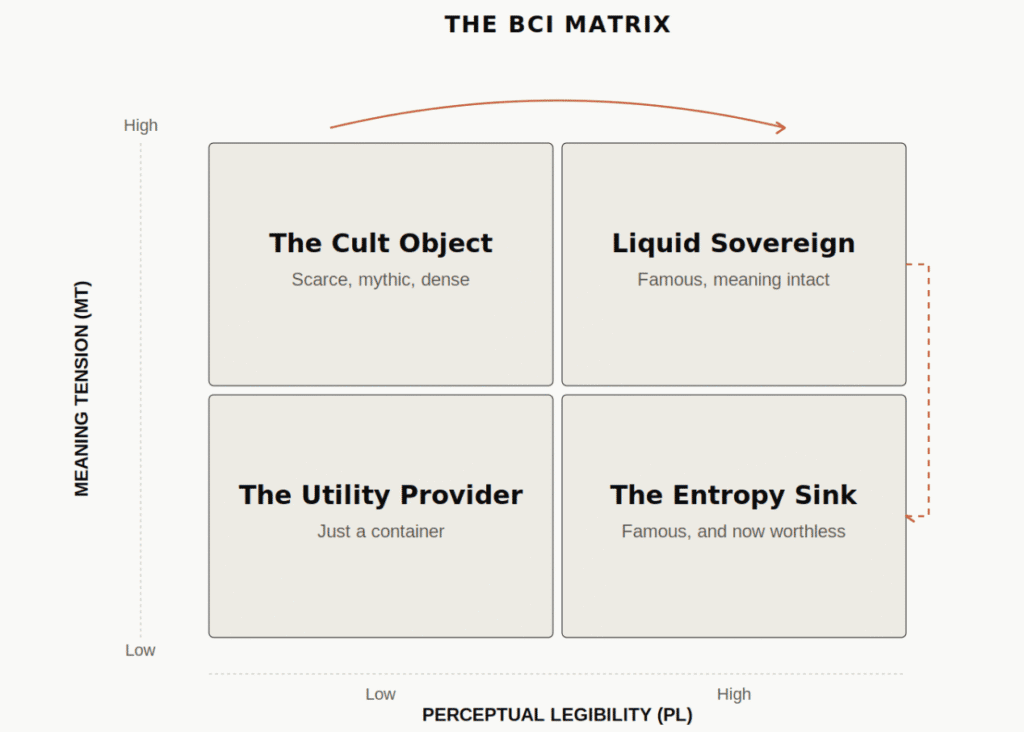
Every sentimental asset sits between two forces: how much meaning it holds, and how easily a stranger can read that meaning.
We call the first Meaning Tension (MT) — the elastic potential energy stored in a symbol, the gap between what an object is (a leather bag, a steel watch, a bottle of fermented grape juice) and what it confers on the person holding it.
High MT indicates that a brand is rich in meaning and not easily decoded. By contrast, low MT suggests a collapse of meaning, where the signifier becomes the signified — a bag is merely a container, a car merely a means of transport.
We call the second Perceptual Legibility (PL) — the degree to which a brand’s structural identity remains decipherable to people outside its original audience. Low PL means a brand requires initiation to understand. High PL means everyone, instantly, knows exactly what it is.
Plot any brand on these two axes, and something becomes visible that no balance sheet shows: brands are not born famous and dense. They are born dense and illegible — and the market rewards them precisely because they’re hard to read.
Growth is the force that drags every brand rightward, toward legibility. What determines what happens next is not a matter of luck or creative direction. It’s governed by exactly two more variables, which we’ll come to.
First, the map itself.
Four Places, No Fifth
The Cult Object— high MT, low PL. Scarce, mythic, largely unexplained to anyone outside its own audience. Hermès does not publish Birkin production numbers, does not explain its waitlist, and does not need to: the asset’s value is the distance between what it costs and what almost no one outside a small circle fully understands about why. This is the most structurally insulated position in the matrix — and the hardest one to stay in, because every dollar of revenue growth pulls the asset toward higher PL.
Liquid Sovereign — high MT, high PL. Famous, and still somehow undefinable. This is the rarest cell in the matrix, not because no one tries to get there, but because most things that achieve global recognition lose their meaning in the process of getting there. Hermès, the house — not just the Birkin — sits here: globally recognized, appearing on every “most valuable brand” list, and still closed 2025 with revenue up 9% at constant exchange rates and an operating margin above 40%. Fame did not cost it anything. That is the entire achievement.
The Utility Provider — low MT, low PL. Not a failure state — a stable one. A well-engineered mid-range vehicle, built for a specific market return with no symbolic surplus attached, is not trying to be a sovereign asset and is not exposed the way one is. There is no shame in this quadrant. It also lacks pricing power.
The Entropy Sink— low MT, high PL. Known by everyone. Revered by no one. This is where a brand lands after years of trading meaning for reach — diffusion lines, logo saturation, collaborations engineered for quarterly volume rather than long-term gravity. It is also, not coincidentally, the only quadrant a brand can climb out of only by doing something that looks like losing money in the short term: cutting SKUs, raising prices without explanation, or disappointing a retail partner. Burberry spent the better part of a decade here before its current restructuring began the — still unproven — work of climbing back toward Liquid Sovereign.
What Moves a Brand Between Quadrants
Two more variables govern motion across this map — and they are the difference between a brand that survives its own growth and one that doesn’t.
Time Structure (TS^n) is the variable that determines whether a brand can carry meaning at scale. It’s the architecture that lets an asset move rightward — toward legibility, toward fame — without the move costing it MT. A 1990 Patek Philippe trades at a premium to its 2026 equivalent; that positive slope is TS^n compounding. A brand whose last decade’s product is worth less than this year’s is not compounding. It’s transacting.
Energy State (ES) determines the direction of the exchange between a brand and its market: whether the brand is feeding its own meaning, or feeding off it. A house that rejects leather hides for imperfections invisible to the naked eye is spending energy nobody asked it to spend — and that “waste” is the entire mechanism by which scarcity gets manufactured rather than merely claimed. A house licensing its name to a fragrance conglomerate to hit a quarterly number is doing the opposite: converting stored meaning into current cash flow, with no plan to replace what was spent.
Brands with high TS^n and Nourishing ES are the ones that survive the trip from Cult Object to Liquid Sovereign. Brands without that architecture take the same trip rightward — toward fame — and land in the Entropy Sink instead, because legibility was always the destination.
What determines the altitude of the landing is TS^n and ES, not marketing budget.
This Is Not a Metaphor
Every variable in this matrix is observable without asking a single consumer how they feel. MT shows up in narrative opacity and acquisition friction. PL shows up in unaided brand recognition outside a brand’s core market. TS^n shows up in the slope of secondary-market pricing on an asset’s own deadstock. ES shows up in production friction ratios — what a brand spends on details no customer will ever see.
None of this requires belief. It requires measurement, the same way a credit rating doesn’t require anyone to feel confident about a bond — it requires cash flows, coverage ratios, and a consistent methodology applied across hundreds of issuers, so the rating means the same thing every time it’s used.
That consistency is the entire point. BCI has run this matrix against more than 80 global brands. The placements hold up before the financial statements catch up — which is, in the end, the only test that matters for an instrument that claims to measure risk rather than describe a mood.
Where a Brand Sits Is Not Where It Stays
Every quadrant in this matrix is a position, not a sentence. Brands move — usually toward legibility, because that’s the direction growth pulls everything, and only sometimes back toward density, because that requires a board willing to look at a slowing topline and call it a strategy rather than a problem.
Most brand valuations are stress-tested against market conditions. None is stress-tested against its own structural coherence. A brand can outperform the market while its internal load-bearing architecture is failing, for exactly as long as it takes the market to notice — and by the time it notices, the repricing is rarely gradual.
The financial system manages credit, liquidity, and market risks through various instruments.
It did not, until now, have one for this.
This is not investment advice and does not constitute a credit rating of any company or asset named above. BCI’s Structural Integrity Index is a proprietary analytical framework, applied consistently but subject to revision as new structural data emerges.
— BCI Lab
BCI Lab outputs indefensible knowns. We map the structure; the market absorbs the consequence.
© 2026 BCI Lab. Written in compliance with BCI Structural Integrity Protocol v3.0.