Institutional Methodology 4 variables

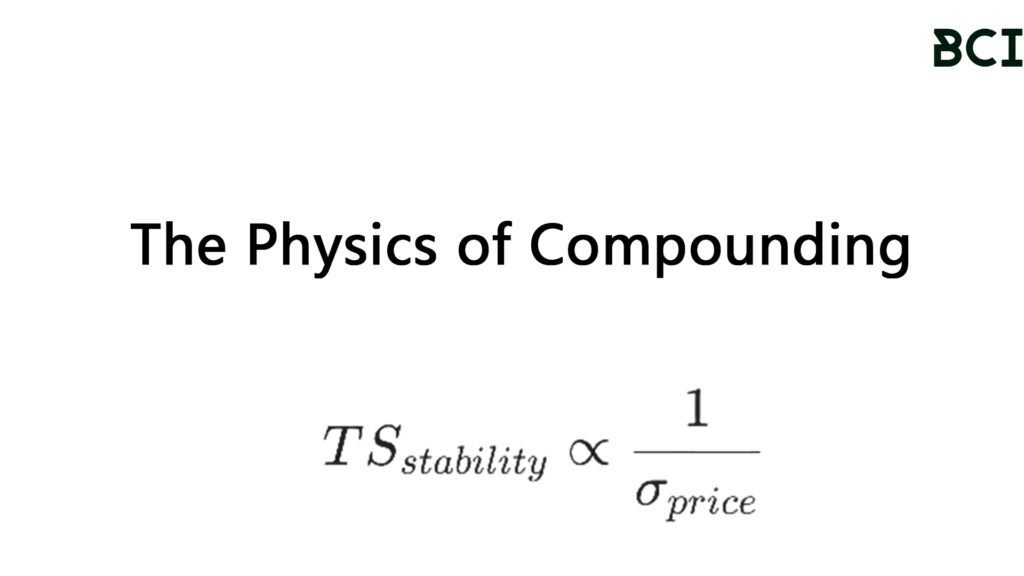
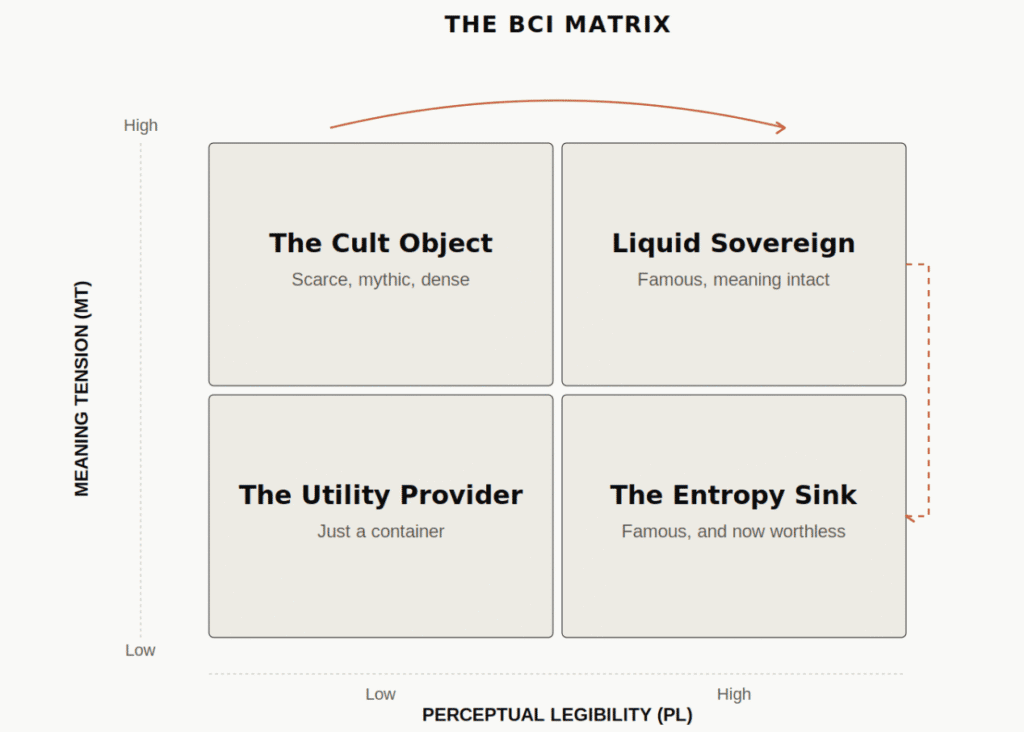
the BCI Structural Dynamics Phase Map — a practical grammar for how intangible assets behave under pressure. The map treats brand, culture, and narrative as a kind of asset physics, with trajectories that are as predictable as capital flows when structure is absent. Without counter‑vailing structure, systems slide along a familiar gradient: ES rises as liquidity and legibility improve, PL trends higher as access friction falls, and MT — meaning tension — is quietly arbitraged away. The natural resting point of that process is the Entropy Sink, where assets trade as undifferentiated commodities. Each axis is parameterized with observable proxies rather than metaphors: semiotic density in the field, SKU dispersion across the shelf, variance in temporal release cadence, and the degree of liquidity compression in secondary markets. These are not aesthetics; they are measurable state variables. In this frame, sovereignty is not a slogan but a kinetic condition. It exists only when a structure can continuously hold an asset at altitude against its own liquidity. TS — temporal structure — is the relevant form of structural armor. It is the only mechanism we repeatedly see that both dampens ES acceleration and preserves high‑altitude pricing power while the system remains highly legible. Across longitudinal panels, accelerated ES drift reliably shows up as a leading indicator: it often appears several quarters before visible gross‑margin compression, long before the P&L tells the story. BCI therefore defines structural sovereignty as the ability to sustain elevated MT under rising PL without triggering ES acceleration. In other words, to increase visibility without quietly selling off the tension that justifies premium economics. Capital is quite efficient at pricing visibility. What markets rarely price correctly is structural tension — the architecture that keeps an asset sovereign instead of letting it sink into industrial clutter.

The MT × PL Matrix: A New Map for Post-Premium Asset Valuation

  Document Category: Public Methodology / Capital Market Infrastructure Protocol Alignment: BSIP v3.0 Maintained by: BCI Governance Committee | BCI Lab     Classical valuation models treat intangible assets (brands, cultural properties) as linear revenue generators. This epistemological flaw creates significant latency in capital markets: traditional financial metrics (EBITDA, Gross Margin) routinely mask the underlying […]

Institutional Methodology 4 variables
The BCI White Paper formulates the structural laws governing premium intangible assets. By deploying the BCI Equation, capital allocators can identify Structural Entropy—the silent deterioration of pricing power—before it manifests as financial erosion. The protocol maps the mathematical relationship between Meaning Tension, Perceptual Legibility, Time Structure, and Energy State to audit Terminal Value sustainability and M&A integration risk

The BCI Lab White Paper v3.0

Quantifying Intangible Asset Valuation, M&A Risk, and Terminal Value       Release Date: March 29, 2026 Document Category: Public Methodology / Capital Market Infrastructure Author: BCI Lab | Structural Dynamics & Asset Audit Protocol Version: The BCI White Paper v3.0 (Replacing v2.1 “Thermodynamics of Sentimental Capital”)     I. THE FUNDAMENTAL PROBLEM: THE LATENCY

Institutional Methodology 4 variables

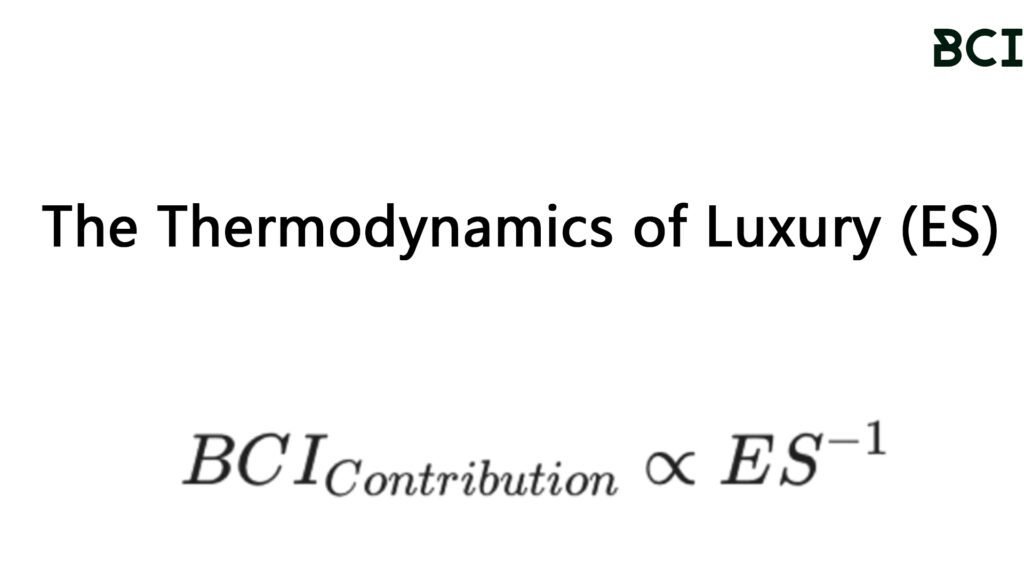
The Thermodynamics of Luxury: Why Efficiency is a Structural Risk

  The Calculus IV: The Energy State (ES^{-1}) and the Physics of Sovereign Waste   Abstract: In the final installment of our “Structural Dynamics” series, BCI Lab deconstructs the fourth and most counterintuitive variable of our valuation model: Energy State (ES). While traditional GAAP accounting rewards operational efficiency, the BCI Structural Integrity Audit treats “frictionless

Institutional Methodology 4 variables

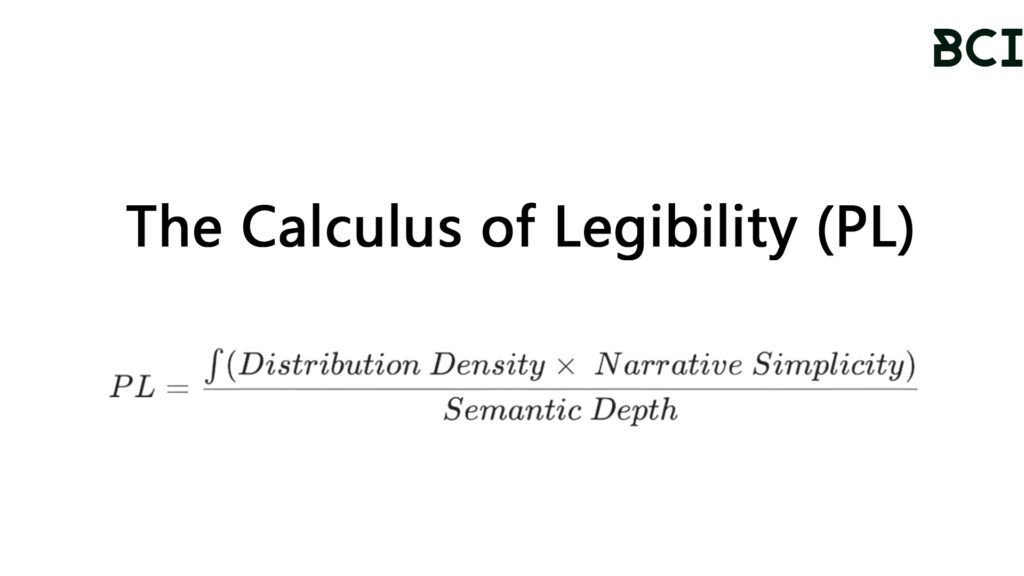
The Calculus of Legibility (PL): Why Optimization is Fragility

  I. The Governance Paradox In the boardroom, the directive is almost always absolute: Remove friction. Optimization teams are deployed to smooth out user journeys, maximize accessibility, and democratize narrative comprehension. They call it Efficiency.   At BCI Lab, we call it Structural Liquidation.   In the physics of sentimental assets, value is not a

Institutional Methodology 4 variables

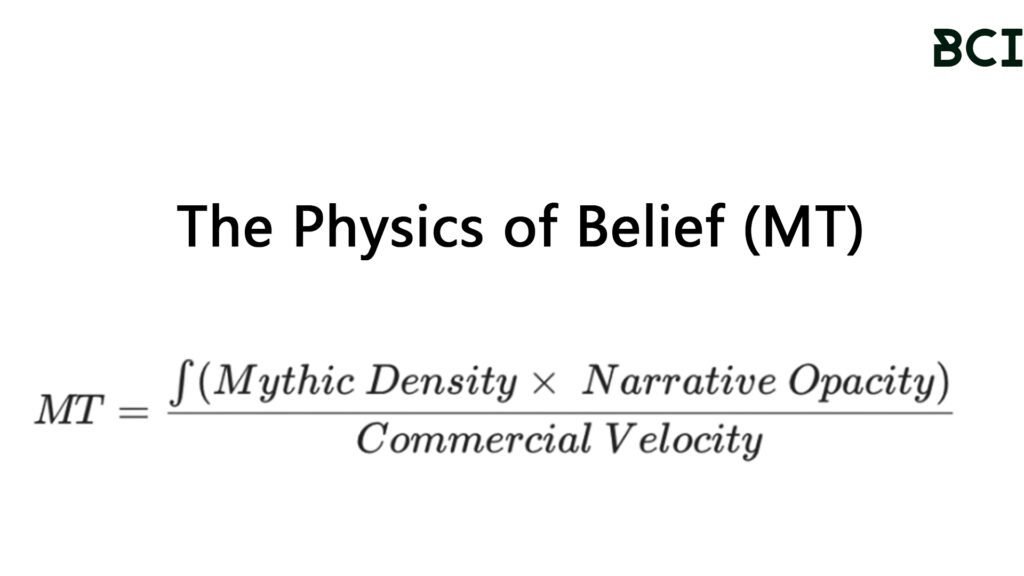
The Physics of Belief (MT): Quantifying Meaning Tension in Asset Valuation

  I. The Governance Paradox In traditional valuation, Brand Equity is a residual plug number—theGoodwill left over when tangible assets are subtracted from the acquisition price. It is treated as magic.   At BCI Lab, we reject magic. We operate on the premise that intangible value is a structural output of Meaning Tension (MT).  

Institutional Methodology 4 variables
Scroll to Top