Document Category: Structural Diagnostics / Capital Market Infrastructure
Protocol Alignment: BSIP v3.0
Maintained by: BCI Governance Committee
This paper addresses a recurring failure pattern in China-based brands attempting premiumization, global expansion (going global / 出海), and luxury positioning through supply-chain excellence alone.
As a structural dynamics laboratory auditing top-tier global assets, we have recently observed a mathematically tragic phenomenon in the cross-border expansion and premiumization efforts of emerging enterprises.
Countless founders—scaling everything from cashmere and advanced skincare to EVs and independent furniture—are marching down a perilous path. They deploy the world’s most advanced supply chains, engineer flawless physical parameters, and attempt to command a price point designed to rival established European luxury houses.
We recognize the urgency of this global expansion. Supply-chain native enterprises possess the most intelligent factories and hyper-efficient operational managers. Yet, when we process these “premium” transition models through the core BCI equation:
BCI = (MT × TS^n) / (PL × ES^{-1})
The diagnostic readings are brutally clear: These assets are physically perfect, but structurally hollow.
This is not a marketing critique; it is a structural audit and a risk-mitigation manual. We must dissect the conflict between Rationalism and Perceptual Gravity to explain why immense operational effort routinely fails to yield sovereign pricing power.
I. The Illusion of Parity: Parameters vs. Gravity
The reigning logic among many operational founders is linear: “My cashmere is sourced from the same supplier as Loro Piana, and my manufacturing tolerances exceed legacy brands. Therefore, my premium valuation is justified.”
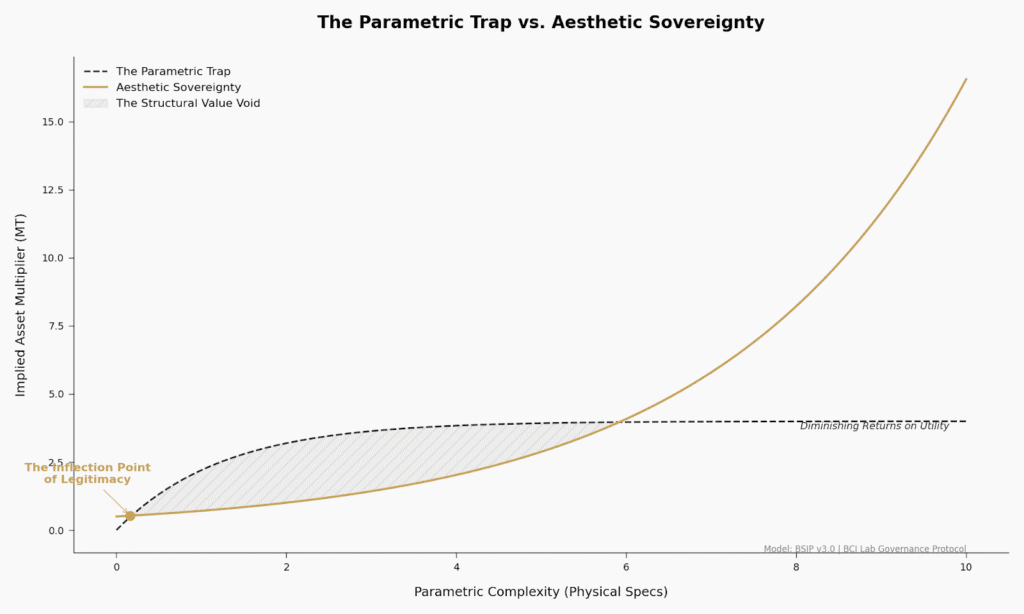
This is the quintessential Parametric Trap.
In the BCI framework, pricing power is not dictated by physical Parameters (P); it is dictated by Meaning Tension (MT).
- The Cognitive Alchemy of Incumbents: Established houses have spent a century injecting history, class, and a calculated sense of the inexplicable into their symbolic systems. That is the physics of asset gravity.
- The Parametric Trap: Emerging premium brands manufacture exceptional physical utilities, but they possess zero narrative mass.
When management attempts to convince capital markets or consumers to pay a premium purely based on micrometer tolerances, fabric counts, or battery density, they are defaulting to a subordinate position. They are applying the logic of “cost-performance ratio” to an arena that operates on “scarcity multiples.”
In the realm of Aesthetic Sovereignty, any metric that can be quantified can be commoditized. If an asset can only defend its price through a spec sheet, it has failed to establish its own gravitational field.
II. The Liability of Efficiency: PL Overload
We must address a systemic vulnerability inherent to manufacturing-led founders: The hostage situation of efficiency. Operational cultures are engineered to solve problems and eliminate friction. In the manufacturing sector, this is a miracle. In the valuation of intangible premium assets, this is categorized as PL (Perceptual Legibility) Overload.
- The Symptom: Brands suffering from this affliction turn their advertising real estate into instruction manuals. They are terrified the market might overlook their supply chain investments, leading to chronic over-explanation.
- The Structural Consequence: The asset becomes aggressively legible. All cognitive friction and mystery are eradicated.
This is precisely the battleground where legacy empires want new entrants to compete. They welcome supply-chain arms races because they control the ultimate heuristic dominance: the definition of what constitutes “luxury.” If you attack their cognitive alchemy with rational science and absolute transparency, you surrender your pricing power the moment you enter the market. You are merely renovating the stage upon which they perform.
III. Governance Options: From Manufacturer to Sovereign
If you are a Private Equity partner underwriting a luxury transition, or a founder steering a global premiumization strategy, you are currently exposed to Asset Collapse Risk. As macroeconomic cycles stabilize, capital and consumers will rapidly abandon expensive parametric substitutes and retreat to assets possessing authentic gravity.
If your premium justification relies primarily on materials, specifications, or manufacturing parity, your asset is structurally classified as a parametric substitute, not a sovereign brand.
To hedge against this structural entropy, capital allocators must enforce the following transitions:
- Divest from Parametric Justification: Terminate the reliance on “materials and specs” as the primary driver of premium multiples. True pricing power requires an irrational, inexplicable dimension.
- Synthesize a TS^n (Time Structure) Moat: Even if your asset lacks a century of archives, you must engineer a proprietary structural narrative that compounds over time, rather than benchmarking against incumbent empires.
- Calibrate your ES (Energy State): Audit your systemic energy. Is your enterprise extracting capital by solving functional pain points, or is it nourishing the market by generating perceptual aspiration?
Capital Interface:
Assets exhibiting high PL (over-explanation, distribution transparency) with low MT should be modeled with:
– Immediate multiple discount vs. incumbent luxury benchmarks
– Elevated CAC assumptions
– Terminal Value compression due to lack of symbolic compounding
Conclusion: Sovereignty Cannot Be Outsourced
The global market does not require another highly efficient, reasonably priced alternative to an incumbent luxury house. It demands assets that command their own structural sovereignty.
If you are operating a high-margin asset but find yourself trapped in an endless cycle of rising Customer Acquisition Costs (CAC) to justify your premium, if you are unsure whether your asset is a gravitational force or merely dust in the BCI matrix:
Initiate a Category A | Structural Snapshot Audit.
BCI Lab’s methodology bypasses marketing noise. We execute MT distribution stress tests and Aesthetic Sovereignty audits to strip away meaningless parametric armor and re-weld your structural chassis.
In an era of infinite supply chain capacity, sovereignty is the only asset that cannot be commoditized. Do not allow your operational excellence to become cheap fuel in a parametric bubble.
1)Definition Block
Parametric Trap
Definition: The structural condition in which an asset attempts to justify premium pricing through measurable physical parameters rather than symbolic gravity (MT).
Implication: Leads to commoditization under luxury pricing attempts.
2)Threshold Block
When PL exceeds MT (as measured by narrative density vs. informational transparency), the asset enters a parametric substitution regime, where pricing power becomes unsustainable.
3)Capital Mapping Block
- High Parameters, Low MT → Commodity Premium Illusion
- High PL → CAC Inflation
- Low TS → No luxury compounding
- ES extraction → Brand exhaustion
© 2026 BCI Lab. Written in compliance with BCI Structural Integrity Protocol v3.0.