Intangible Asset Pricing Infrastructure

The Observer of Structural Blind Spots: Why Elite Capital Fails to Audit the “Soul” of a Brand

  Before we proceed, a necessary clarification: BCI Lab does not provide brand consulting. We perform Structural Dynamics Audits on semiotic assets.   My trajectory—from the rigorous logic of high finance to the high-velocity turbulence of digital media, and eventually founding the fragrance house UMFD—was not a series of career shifts. It was a decade-long […]

Intangible Asset Pricing Infrastructure
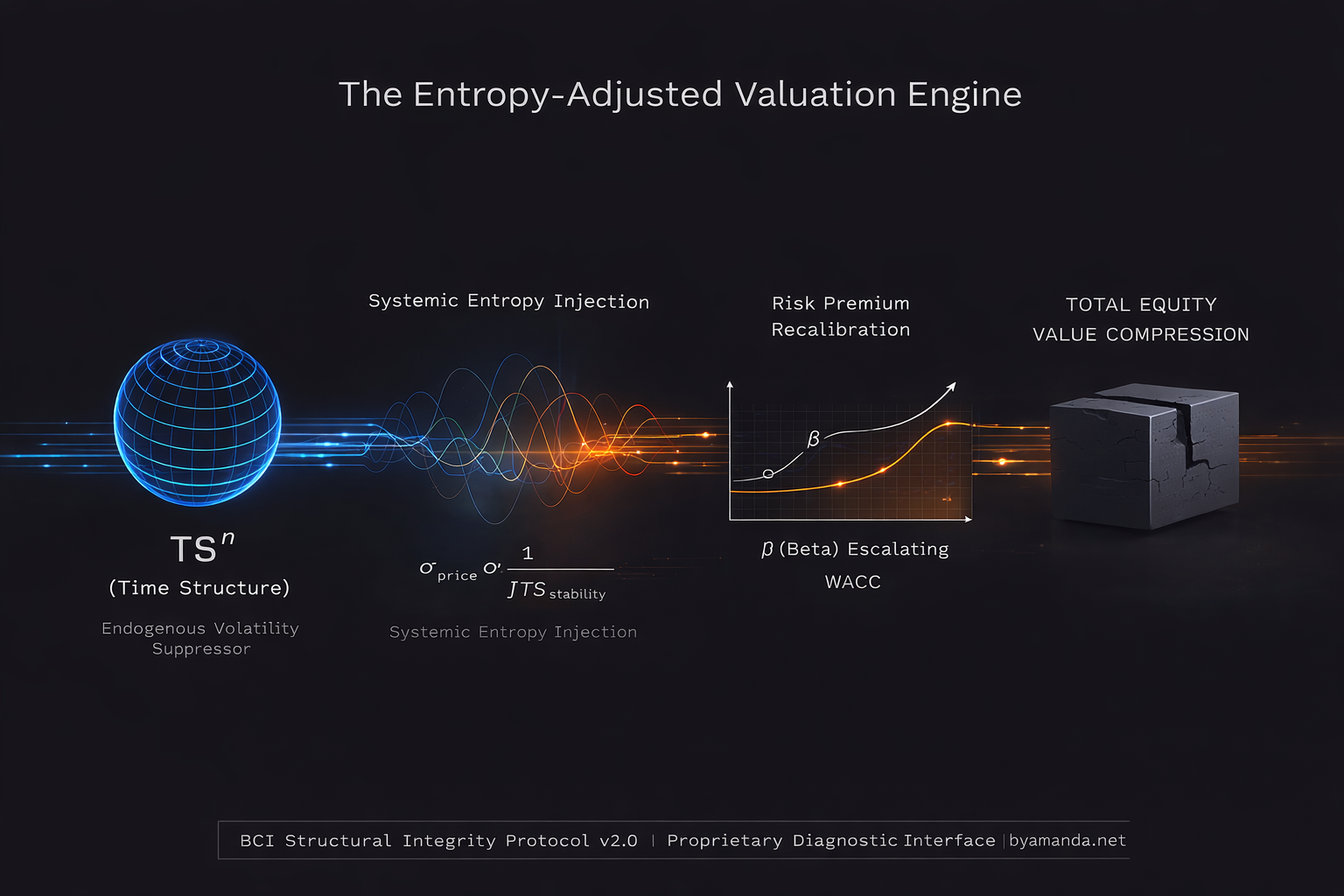
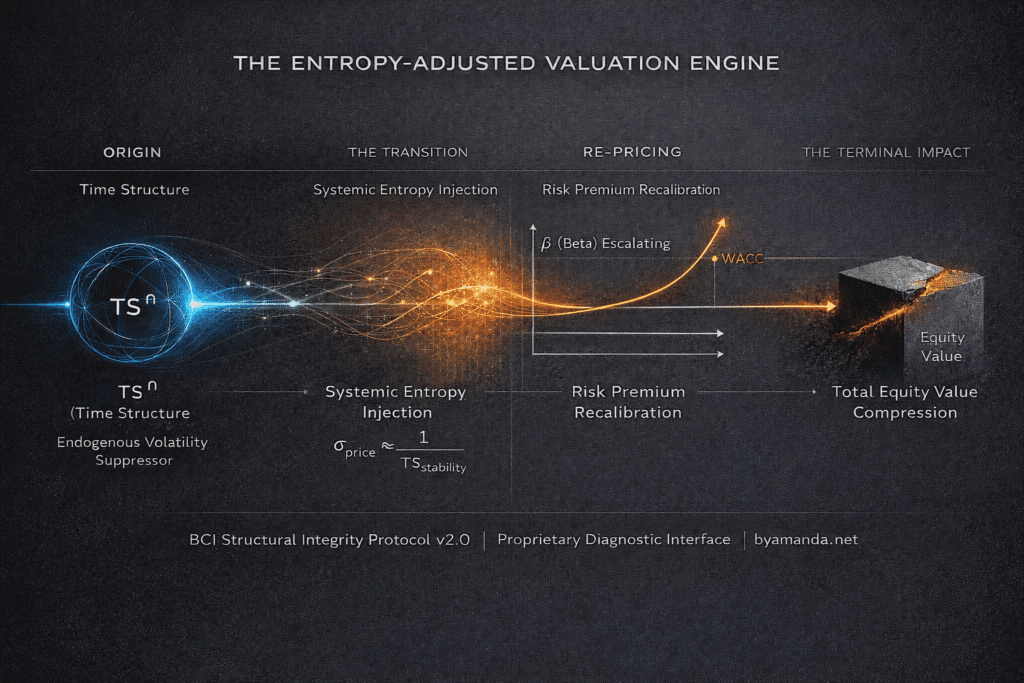
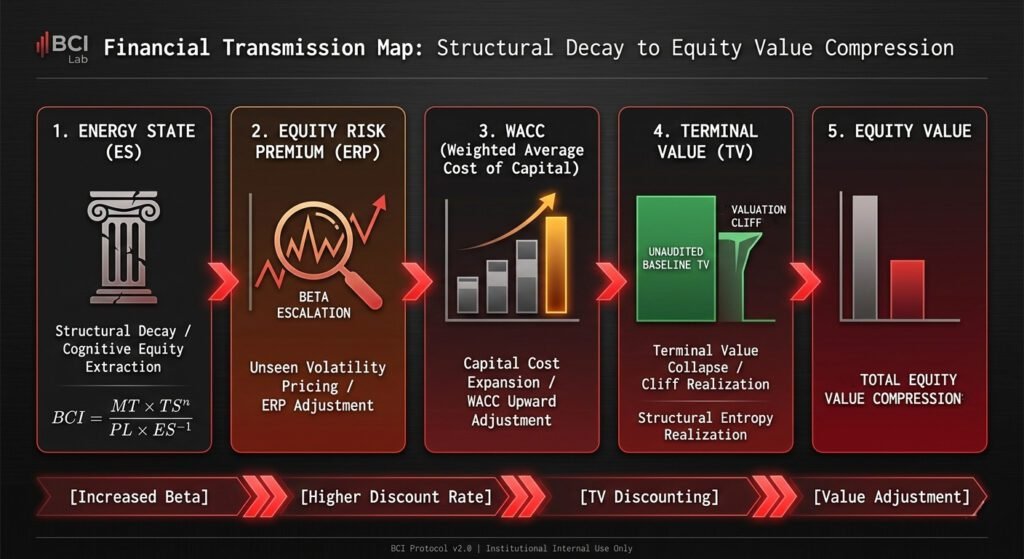
A financial infographic mapping the BCI Structural Integrity Protocol v2.0 financial transmission mechanism. It illustrates how the degradation of endogenous volatility suppressors—specifically the Time Structure (TS^n)—leads to a causal chain resulting in terminal value compression. The four-stage process shows: 1. The Origin of Time Structure as an endogenous volatility dampener; 2. The Transition through Systemic Entropy Injection, modeled by the relationship σ_{price}∝ 1/TS_{stability}; 3. The Quantitative Shift where Beta (β) escalates and WACC (Weighted Average Cost of Capital) drifts upward; and 4. The Terminal Impact, showing high-convexity compression of the Total Equity Value multiple. The infographic concludes that capital mispricing happens at underwriting due to unmodeled structural entropy detected long before a Goodwill Impairment trigger. Footered for byamanda.net.

 Intellectual Governance| Establishing a New Global Standard for Sentimental Asset Auditing

    Executive Summary | Redefining Fiduciary Duty in the Intangible Economy The global accounting standards (IFRS/GAAP) provide a robust, albeit retrospective, framework for financial reporting. However, in the context of cognitive-heavy assets, these standards exhibit a systemic latency gap between structural decay and accounting recognition.   The BCI Lab introduces the Structural Integrity Protocol

Intangible Asset Pricing Infrastructure

The Volatility Suppression Index| Predicting Asset Resilience Through Time Structure (TS^n)

  Executive Summary | Structural Diagnostic: Rethinking the Economic Moat In quantitative finance and institutional risk management, standard deviation (sigma) is conventionally treated as an exogenous byproduct of market forces.    An Economic Moat is a dynamically maintained Time Structure (TS^n) that suppresses volatility and stabilizes discount rates.   This report recalibrates that consensus by

Intangible Asset Pricing Infrastructure
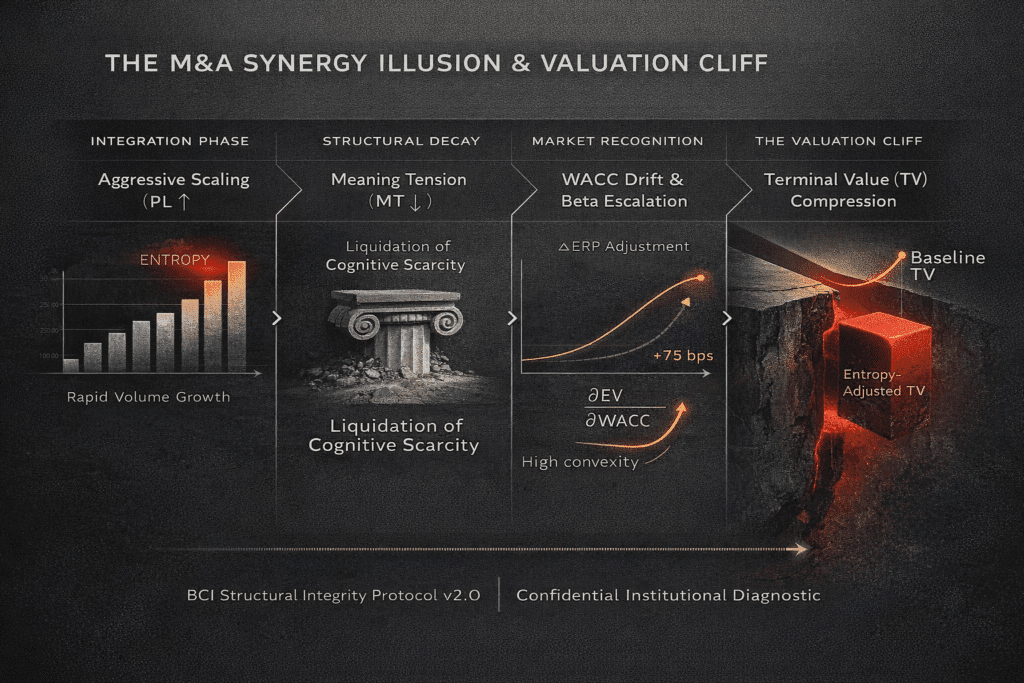
M&A Due Diligence Infographic: The transmission map from brand structural decay and Perceptual Legibility (PL) escalation to WACC expansion and Terminal Value (TV) compression. This chart illustrates why aggressive synergy scaling in Private Equity buyouts leads to the 'Valuation Cliff' and subsequent Goodwill Impairment, demonstrating the convexity of Equity Value relative to a 75bps drift in the discount rate.

M&A Due Diligence v2.0| Auditing Cognitive Structural Integrity in Post-Acquisition Assets.

    Executive Summary | Structural Diagnostic: The Synergy Illusion in M&A In the current landscape of Private Equity buyouts and corporate M&A, the dominant failure mode of post-merger integration is not operational inefficiency, but the systemic destruction of the target’s cognitive pricing power.   Traditional M&A Due Diligence and Synergy Valuation models routinely mistake

Intangible Asset Pricing Infrastructure

Quantifying Premium Decay|A Structural Dynamics Approach to Brand Pricing Power.

    Structural Diagnostic|The Systemic Mispricing of Premium The current financial architecture for Brand Valuation and Intangible Asset Pricing suffers from a fundamental latency: it treats Pricing Power as a static Economic Moat rather than a dynamic thermodynamic system. This report identifies a critical Risk Premium Miscalculation in legacy DCF (Discounted Cash Flow) and ROIC

Intangible Asset Pricing Infrastructure

Traditional Intangible Asset Valuation is Failing | The Structural Limits of Goodwill Impairment

  Executive Summary | Cognitive Asset Pricing Infrastructure The systemic lag in traditional financial reporting—specifically regarding Goodwill Impairment and Intangible Asset Valuation—has created a “defensive ignorance” within capital allocation.    Goodwill is treated here not as an accounting residue, but as a misclassified structural signal within cognitive asset pricing infrastructure.   This report executes a

Intangible Asset Pricing Infrastructure
Scroll to Top