BCI-Lab

Amanda Zhang is the founding partner of BCI Lab, a structural risk institution focused on auditing intangible assets, brand sovereignty, and long-cycle value systems. Trained in finance and accounting, with a decade-long background in cultural systems and perception economics, her work translates meaning, time, and human behavior into auditable governance frameworks. BCI Lab was built at this intersection — not to optimize performance, but to reduce structural blind spots before value erosion becomes irreversible. BCI Lab (Brand Capital Integrity) An independent structural audit institution focused on quantifying the integrity, decay, and compounding dynamics of intangible assets.

From Brand Climate to Capital Integrity: An Open Protocol for Asset Allocators

    Protocol Alignment: BSIP v3.0 Maintained by: BCI Governance Committee     For years, as capital markets have been observed and consumer assets have been actively built, a structural schism has been evident within corporate boardrooms.   In the investment committee room, partners and CFOs obsess over discounted cash flows and EV/EBITDA multiples. In […]
Governance & Protocol Framework
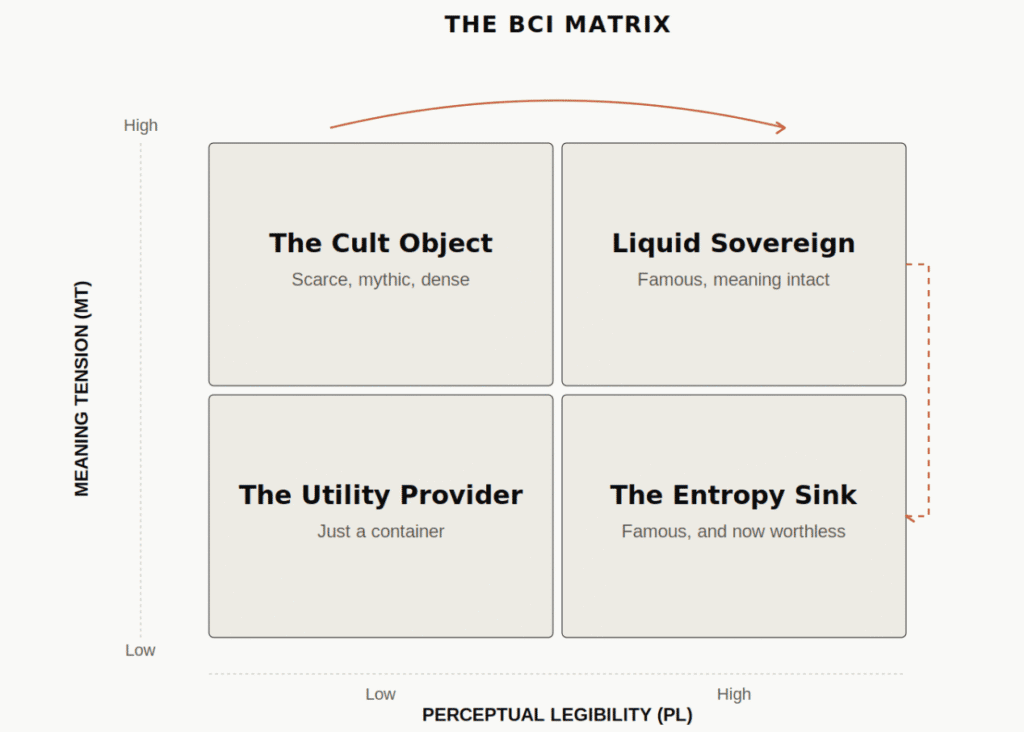
the BCI Structural Dynamics Phase Map — a practical grammar for how intangible assets behave under pressure. The map treats brand, culture, and narrative as a kind of asset physics, with trajectories that are as predictable as capital flows when structure is absent. Without counter‑vailing structure, systems slide along a familiar gradient: ES rises as liquidity and legibility improve, PL trends higher as access friction falls, and MT — meaning tension — is quietly arbitraged away. The natural resting point of that process is the Entropy Sink, where assets trade as undifferentiated commodities. Each axis is parameterized with observable proxies rather than metaphors: semiotic density in the field, SKU dispersion across the shelf, variance in temporal release cadence, and the degree of liquidity compression in secondary markets. These are not aesthetics; they are measurable state variables. In this frame, sovereignty is not a slogan but a kinetic condition. It exists only when a structure can continuously hold an asset at altitude against its own liquidity. TS — temporal structure — is the relevant form of structural armor. It is the only mechanism we repeatedly see that both dampens ES acceleration and preserves high‑altitude pricing power while the system remains highly legible. Across longitudinal panels, accelerated ES drift reliably shows up as a leading indicator: it often appears several quarters before visible gross‑margin compression, long before the P&L tells the story. BCI therefore defines structural sovereignty as the ability to sustain elevated MT under rising PL without triggering ES acceleration. In other words, to increase visibility without quietly selling off the tension that justifies premium economics. Capital is quite efficient at pricing visibility. What markets rarely price correctly is structural tension — the architecture that keeps an asset sovereign instead of letting it sink into industrial clutter.

The MT × PL Matrix: A New Map for Post-Premium Asset Valuation

  Document Category: Public Methodology / Capital Market Infrastructure Protocol Alignment: BSIP v3.0 Maintained by: BCI Governance Committee | BCI Lab     Classical valuation models treat intangible assets (brands, cultural properties) as linear revenue generators. This epistemological flaw creates significant latency in capital markets: traditional financial metrics (EBITDA, Gross Margin) routinely mask the underlying

Institutional Methodology 4 variables

BCI STRUCTURAL INTEGRITY PROTOCOL (BSIP) V3.0

  System Constitution & Capital Governance Standard | Version 3.0   Methodology Disclosure: Refer to Institutional Methodology Disclosure v2.0     DOCUMENT CONTROL   I. THE FUNDAMENTAL THEOREM: THE LATENCY OF STRUCTURAL ENTROPY In contemporary capital markets, standard financial accounting models capture the current realization of revenue but fail to measure the structural capacity of

Governance & Protocol Framework

The Observer of Structural Blind Spots: Why Elite Capital Fails to Audit the “Soul” of a Brand

  Before we proceed, a necessary clarification: BCI Lab does not provide brand consulting. We perform Structural Dynamics Audits on semiotic assets.   My trajectory—from the rigorous logic of high finance to the high-velocity turbulence of digital media, and eventually founding the fragrance house UMFD—was not a series of career shifts. It was a decade-long

Intangible Asset Pricing Infrastructure

BCI  Lab  Structural Integrity Review – Nike (Category C )

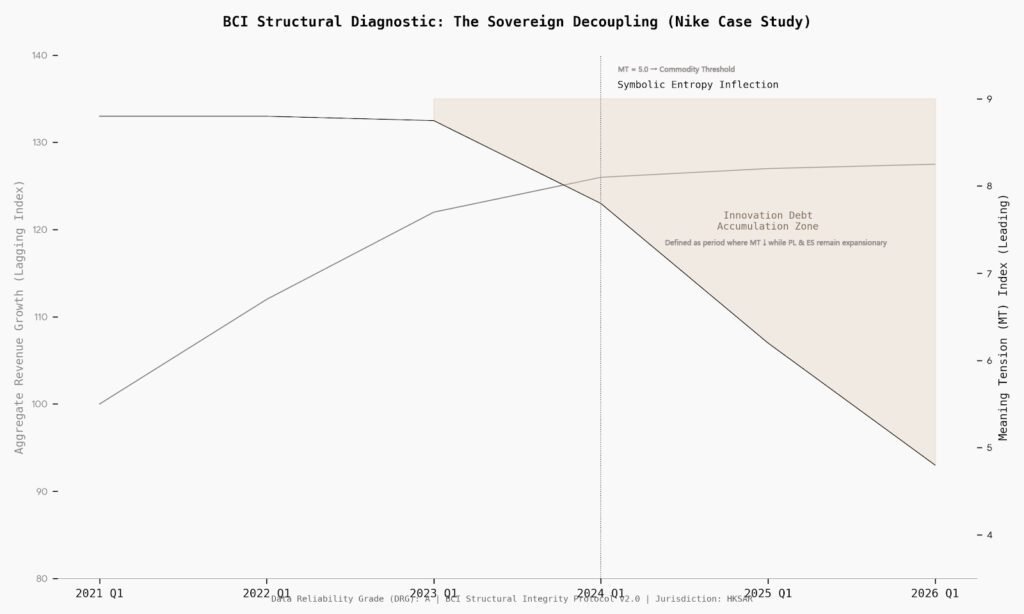
  I. Institutional Header   II. Executive Summary: Structural Status Reading The Phenomenon: Nike is experiencing significant compression in secondary-market valuation alongside a deceleration in premium-channel revenue. Recent equity de-ratings are widely attributed to regional macroeconomic headwinds (EMEA, APAC) and temporary inventory imbalances.   The Latency Gap: Current financial metrics (revenue, gross margin) reflect past

BCI Report

BCI Structural Integrity Report: Anta Group × MAIA ACTIVE

  Post-M&A Sovereignty Transition Phase | Premium Athleisure Sector (China)     I. Institutional Header   II. Executive Summary The structural integration of MAIA ACTIVE into the Anta Group vertical management system serves as a Canonical Case of Institutional Entropy within the community-logic asset class. Following the 2026 transition to secondary-generation leadership, the asset has

BCI Report
The official protocol governing the execution and delivery of BCI structural audits under BSIP v2.0. This document outlines the epistemology of BCI data, the filtration of marketing noise, the Data Reliability Grade (DRG) framework, and the standardized taxonomy of Category A, B, and C diagnostic reports.

BCI AUDIT PROTOCOL v2.0 DOCUMENTATION

  Standardizing Structural Diagnostics & Data Governance for Capital Markets     DOCUMENT CLASSIFICATION: PUBLIC INFRASTRUCTURE PROTOCOL VERSION: BSIP v2.0 Effective Date: March 30, 2026 Supersedes: v1.1 ISSUING BODY: BCI LAB | STRUCTURAL DYNAMICS & ASSET AUDIT     This document serves as the operational constitution for BCI Lab under the BSIP v2.0 Sentimental Asset

Governance & Protocol Framework
The BCI White Paper formulates the structural laws governing premium intangible assets. By deploying the BCI Equation, capital allocators can identify Structural Entropy—the silent deterioration of pricing power—before it manifests as financial erosion. The protocol maps the mathematical relationship between Meaning Tension, Perceptual Legibility, Time Structure, and Energy State to audit Terminal Value sustainability and M&A integration risk

The BCI Lab White Paper v3.0

Quantifying Intangible Asset Valuation, M&A Risk, and Terminal Value       Release Date: March 29, 2026 Document Category: Public Methodology / Capital Market Infrastructure Author: BCI Lab | Structural Dynamics & Asset Audit Protocol Version: The BCI White Paper v3.0 (Replacing v2.1 “Thermodynamics of Sentimental Capital”)     I. THE FUNDAMENTAL PROBLEM: THE LATENCY

Institutional Methodology 4 variables

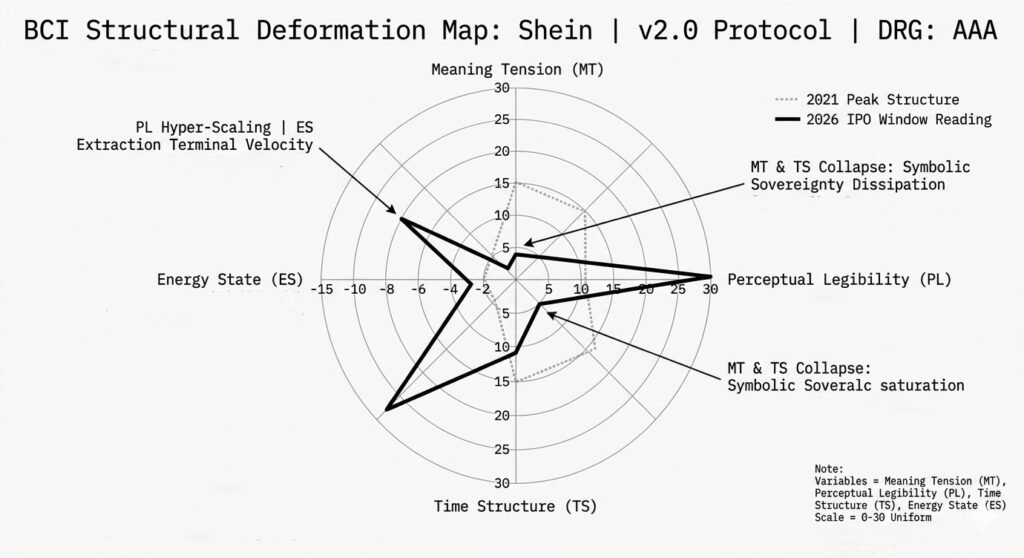
BCI  Lab Structural Diagnostic Report: Shein|Category C

Phase: Pre-IPO Institutional Review | Asset Class: Algorithmic Retail     I. Institutional Header Research Classification Dataset Reference: All BCI readings are calibrated against a cross-sector dataset of 50+ consumer and platform assets (2016–2026), incorporating high-frequency transaction data, distribution density, and secondary market behavior proxies.     II. Executive Summary The structural architecture of the

BCI Report
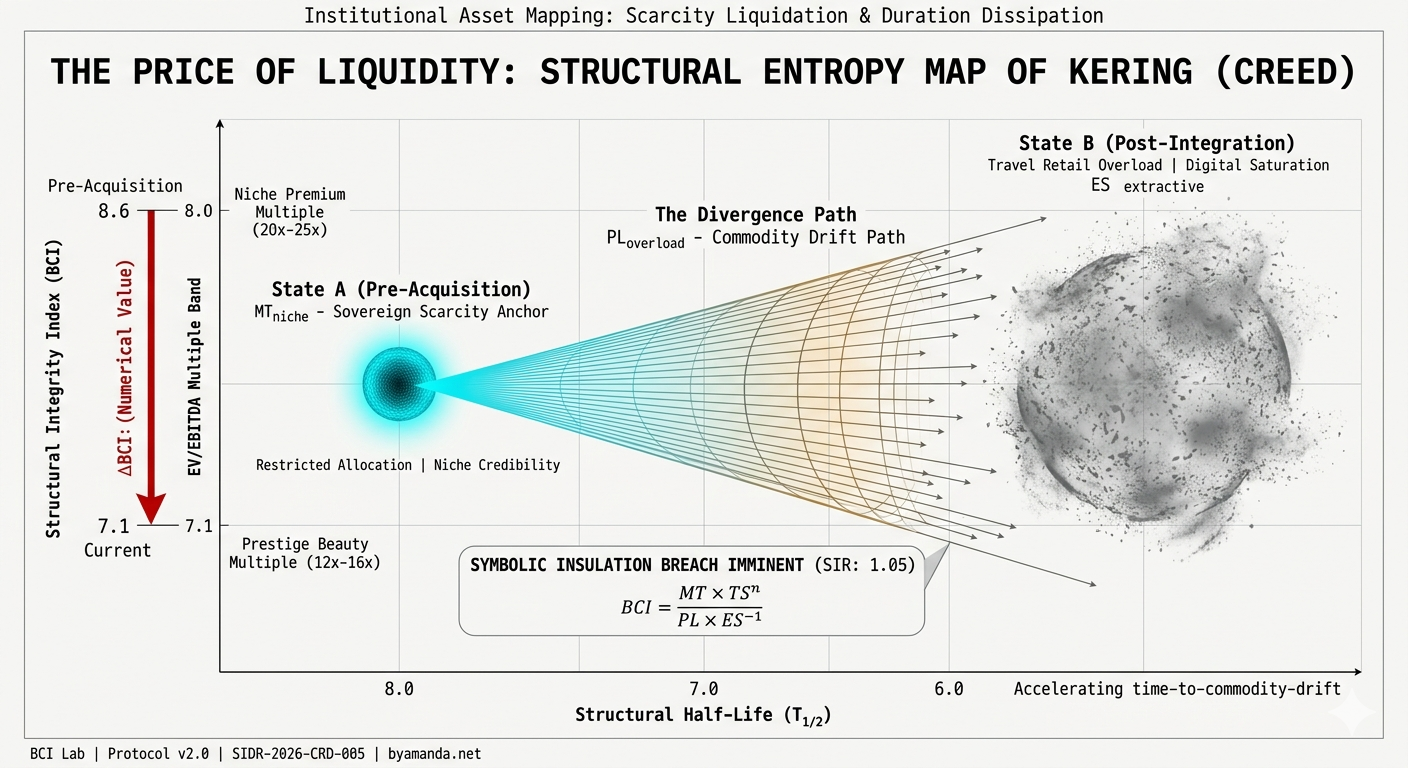
An institutional structural integrity diagnostic mapping Kering's management of Creed (SIDR-2026-CRD-005). The visualization models the 'Liquidation of Scarcity' canonical mechanism. A pre-acquisition 'Sovereignty Scarcity Anchor' (BCI 8.6) transitions via commodity drift (PL overload) to a post-integration 'Scarcity Liquidation Zone' (BCI 7.1) .The map explicitly quantifies a \Delta BCI of -1.5 (high velocity dissipation). It correlates this structural decay directly to the asset's 'Half-Life' (T_{1/2}) and provides 'Valuation Mapping' that shows the corresponding compression of EV/EBITDA multiples from a Niche Premium band to a generic Prestige Beauty band. The final conclusion indicates imminent symbolic insulation breach, with SIR at 1.05. Footered for BCI Lab byamanda.net

BCI  Lab  Structural Integrity Review – Creed (Category C )

  I. Institutional Header   Dataset Reference: All BCI readings and derived indicators are calibrated against a standardized dataset covering 30+ global luxury and niche fragrance assets over the 2016–2026 period, incorporating distribution density, pricing dispersion, and secondary market liquidity proxies.     II. Executive Summary: Structural Status Reading   The Phenomenon: Kering Beauté has

BCI Report
Scroll to Top