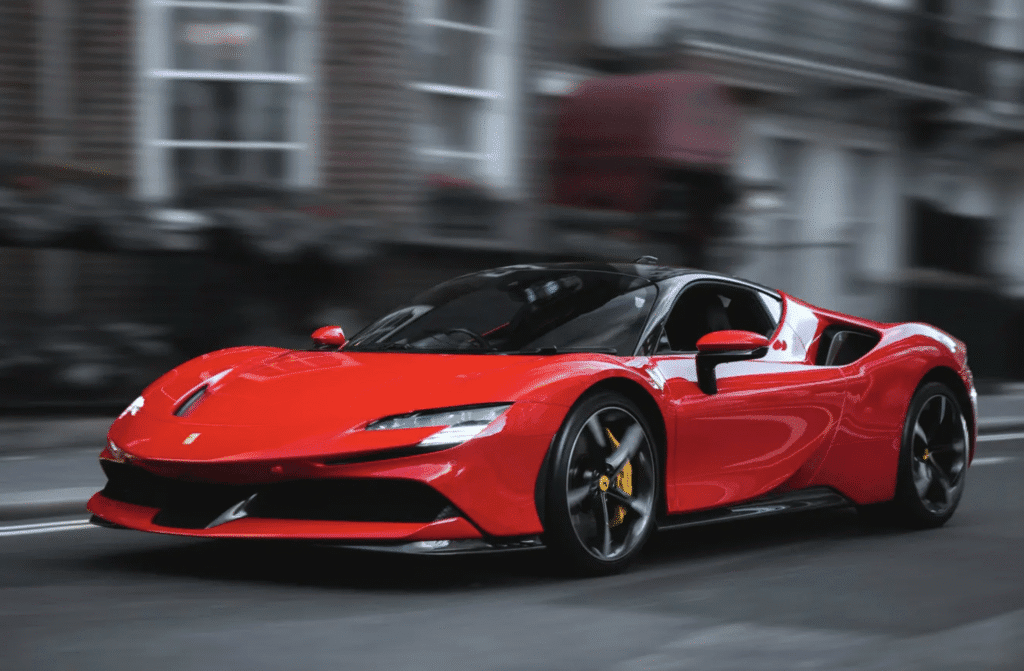
If you caught the headline without the context, it reads like a contradiction.
Ferrari — the brand every profile describes as the one true holdout, the waitlist so entrenched that even loyal, decades-long clients reportedly wait years for an allocation — just had its worst single trading day since its 2015 listing. Seven months later, it had a second one almost as bad.
Two crashes. Zero change to the thing that supposedly makes Ferrari Ferrari: you still can’t just buy one. The order book, as of this writing, runs through the end of 2027.
So what, exactly, got priced?
Run it through BCI’s equation — BCI = (MT × TS^n) / (PL × ES⁻¹) — and the answer isn’t “nothing.” The market identified a real structural risk. It just applied the fear to the wrong asset.
I. What Actually Happened, in Order
October 9, 2025. At its Capital Markets Day, Ferrari previewed the technology behind its first electric model — then codenamed “Elettrica” — and simultaneously walked back its 2030 electrification target, from 40% fully electric down to 20%, rebalancing toward a 40% ICE / 40% hybrid / 20% EV lineup mix.
Management also guided to roughly €9 billion in 2030 revenue and at least €3.6 billion in EBITDA — solid numbers on their own terms, but read by the market as conservative relative to a stock priced for something closer to perfection.
NYSE-listed shares closed down 15% that day, the worst single session since the IPO, eclipsing the previous record of -12.4% set in February 2016.
May 25–26, 2026. The production version of that car — now named the Luce — had its public unveiling in Rome. Four doors, five seats, a 2.2-tonne liftback co-designed with Jony Ive’s LoveFrom studio and Marc Newson, priced from €550,000 (roughly $640,000), which makes it the most expensive production EV in the world. Quad-motor, 1,036 horsepower, an 800-volt architecture, a 122kWh battery.
On paper, a genuine engineering flex.
On sight, social media spent the following twenty-four hours comparing it to a Honda Accord, an Apple Store on wheels, and a “luxury toaster.” Milan-listed shares fell as much as 7–8% intraday; NYSE shares dropped 5.3%. Roughly £3–4 billion came off the market cap in a single session. The stock is now down 25–32% from its 2025 peak above €440.
Neither event touched the order book for an actual Ferrari.
II. What an Angry Former Chairman Got Structurally Right
The most useful data in this entire episode didn’t come from a financial model. It came from people reacting emotionally, in public, without knowing they were describing a mechanism.
Anthony Dick, an auto analyst at Oddo BHF, called the Luce reaction “by far the sharpest reaction we’ve seen for a car design,” and went further: the model represents “the furthest deviation from the brand’s ethos we’ve ever seen.”
Luca di Montezemolo — Ferrari’s chairman from 1991 to 2010, the era of the F50, Enzo, and LaFerrari — was reportedly harsher still in private, and publicly suggested that if Ferrari wanted to be honest about what it had built, it should remove the prancing horse from the car.
Neither of them was making an argument about backlog length, production caps, or delivery schedules. They were making an argument about what the badge means — independent of how many units get built.
That is not a demand-side complaint. It’s a structural one. In BCI’s terms, it’s a live, real-time articulation of $MT$: the gap between what an object is and what it confers on the person holding it, and specifically, whether that gap survives contact with an object that a chairman of the company itself is publicly disowning.
Ferrari’s own commercial chief, Enrico Galliera, has said client interest in the Luce is trending toward a higher share of existing collectors than the roughly 80%-new-customer split Ferrari originally communicated.
Independent dealer checks cited by Evercore ISI’s Michael Binetti found the opposite: “very little demand from existing Ferrari clients.” Both things are being said by informed people, in public, at the same time. That contradiction hasn’t resolved yet — which turns out to matter for what comes next.
III. The Backlog Never Read the Headlines
Three weeks before the Luce reveal, on May 5, 2026, Ferrari reported first-quarter results.
Deliveries fell 4.4% year-over-year, to 3,436 units — a deliberate pullback tied to a model changeover, not a demand problem. Revenue rose anyway: €1.85 billion, up 6% at constant currency. EBITDA margin expanded to 39.1%, from 38.7% a year earlier. Full-year guidance — roughly €7.5 billion in revenue, EBITDA margin at or above 39% — was reaffirmed without qualification.
Read that sequence again: Ferrari shipped fewer cars and made more money doing it. That is not a company straining to defend volume. That is $MT$ functioning exactly as the model predicts it should — pricing power that doesn’t require unit growth to compound.
The discipline behind it isn’t new, and it isn’t a slogan. Since the Purosangue’s 2022 launch, Ferrari has held its SUV — by a wide margin the easiest model in the lineup to oversell — to a hard ceiling of 20% of annual deliveries.
CEO Benedetto Vigna confirmed the figure directly, and it has not moved through four years of demand that, by Ferrari’s own account, has consistently outpaced what the company allows itself to build.
In a category where every direct comparison point — Lamborghini’s Urus, the Bentley Bentayga, the Rolls-Royce Cullinan — chose volume over restraint, Ferrari’s cap is the closest thing in this entire series to a controlled experiment: the counterfactual sitting right next to the test case, run by competitors, in the same market, over the same years.
This is $TS^n$ and $ES$ operating together, not as brand narrative but as a P&L outcome.
Time Structure holds because production genuinely can’t be rushed past a self-imposed ceiling the company has kept for half a decade under real commercial pressure to break it.
Energy State reads as nourishing because Ferrari is visibly willing to forgo revenue — real, bookable, quarter-over-quarter revenue — to protect a structural position instead of extracting against it.
None of that changed in October. None of it changed in May.
IV. The Test That Hasn’t Resolved Yet
Here’s what BCI won’t do: call this closed.
The risk Dick and Montezemolo are actually pointing at isn’t volume cannibalization — Luce buyers, on any account of the data, are largely not the same people bidding for a 12Cilindri allocation. The risk is signifier contamination: whether a prancing-horse badge that a former chairman is publicly disowning starts to mean something measurably different when it’s stitched to a car every other Ferrari owner in the room agrees isn’t one.
That’s a slower-moving, harder-to-fake variable than a delivery number, and it hasn’t had time to show up anywhere yet.
Luce deliveries don’t begin until the fourth quarter of 2026 at the earliest.
The honest position is that this is now an open structural test, not a settled one — which is precisely why it’s worth naming the specific things that would resolve it in either direction, rather than declaring victory on data that predates the product actually reaching a driveway.
The original BCI diagnostic on this asset, filed in March 2026, set its own falsifiability conditions before any of this played out: a breach of the 20% Purosangue cap, or backlog coverage compressing below eighteen months, would each independently invalidate the “sovereign tier” read.
Neither has happened. To that, this update adds a third, sharper condition specific to the Luce: measurable softening in resale premiums or allocation wait times on core ICE and hybrid models, in the two to four quarters after Luce deliveries actually begin.
That is the number that would tell you whether the badge got diluted. Not the stock chart. Not the comment section.
Three Ways to Have Watched This From the Sidelines
If you sold RACE, or seriously considered it, after either drop.
The instinct to react to a 15%-in-a-day move, or a design getting compared to a minivan, isn’t unreasonable on its face. What’s worth separating is whether you were pricing the thing that was actually damaged, or the thing that was merely loud that week.
If you held through both drops on some version of “Ferrari always figures it out,” even without being able to fully articulate why, you were structurally correct. What you have now is a more specific—and more verifiable—basis than brand loyalty: a five-year unbroken production cap, and a quarter in which the company cut volume yet still grew revenue.
If you’ve never looked at RACE and assumed a stock that can fall 15% in a day, twice in eight months, can’t possibly be the “safe” luxury name everyone talks about.
That’s a fair read of the chart. It’s a less complete read of what the chart was actually responding to in each instance — and neither instance was the order book.
What This Confirms, and What It Doesn’t Yet
The original thesis behind adding Ferrari to this series was narrow: does a structural framework built on symbolic, semiotic variables — meaning, legibility, scarcity — hold up in an ostensibly industrial category, where the product is measured in horsepower and lap times rather than craft mythology alone?
On the evidence available through two market panics and one quarter of real financial results, it does.
The mechanism that protects Ferrari’s pricing power looks, line for line, like the mechanism that protects Hermès’s — a self-imposed ceiling the company will not break under real demand pressure, held long enough that the market has started pricing the discipline itself.
What isn’t yet confirmed is whether that mechanism survives contact with a product built, by design, to be legible to people who have never wanted a Ferrari before. That verdict lands sometime after Q4 2026.
BCI will be watching the resale data, not the headlines, when it does.
Next in this series: Nike, and the clearest case yet in this framework of $PL$ overshoot degrading a dominant $MT$ position that, a decade ago, looked nearly as durable as this one.
This note is a structural read, not investment advice, and does not constitute a credit rating of Ferrari N.V., RACE, or any security. BCI’s Structural Integrity Index is a proprietary analytical framework; all readings are subject to revision as new structural or financial data emerges.
Reassessment trigger: any breach of the 20% Purosangue production cap; order backlog coverage compressing below 18 months; or measurable softening in resale premiums or allocation wait times for core ICE/hybrid models in the 2 to 4 quarters following the start of Luce deliveries. Governing reference: Hong Kong law.
For the framework against which this case is plotted, see The BCI Matrix →.
If there’s another asset where the market’s reaction and the structural reality have quietly diverged, reply with the name. It goes in the queue.
— BCI Lab