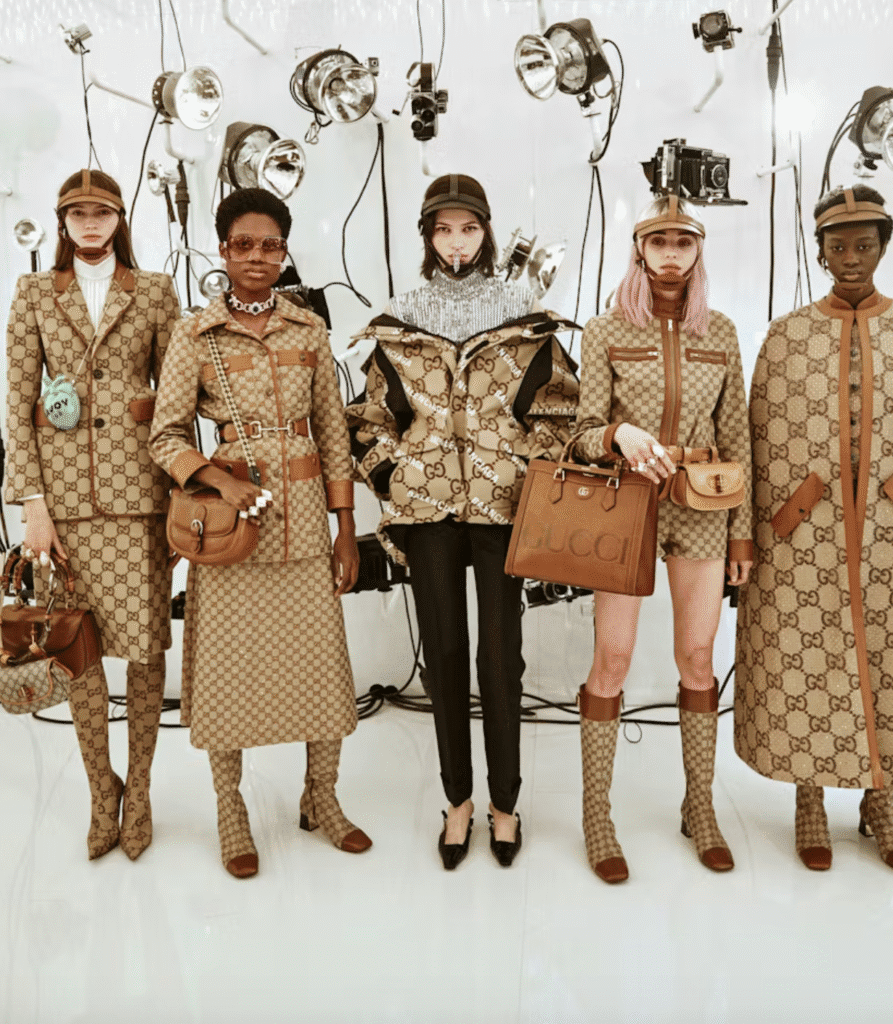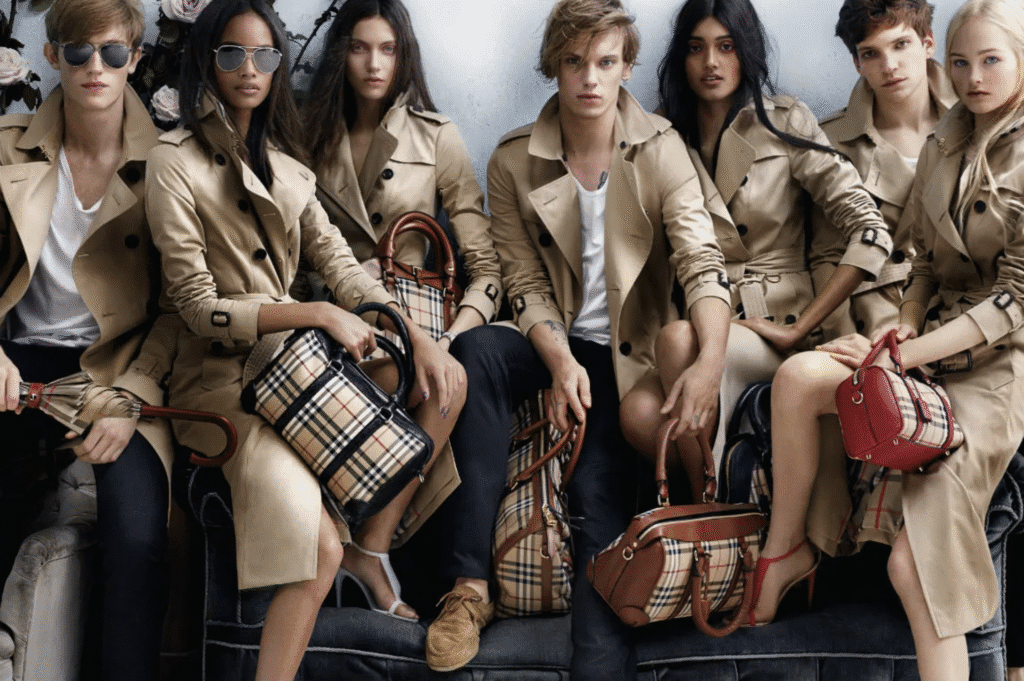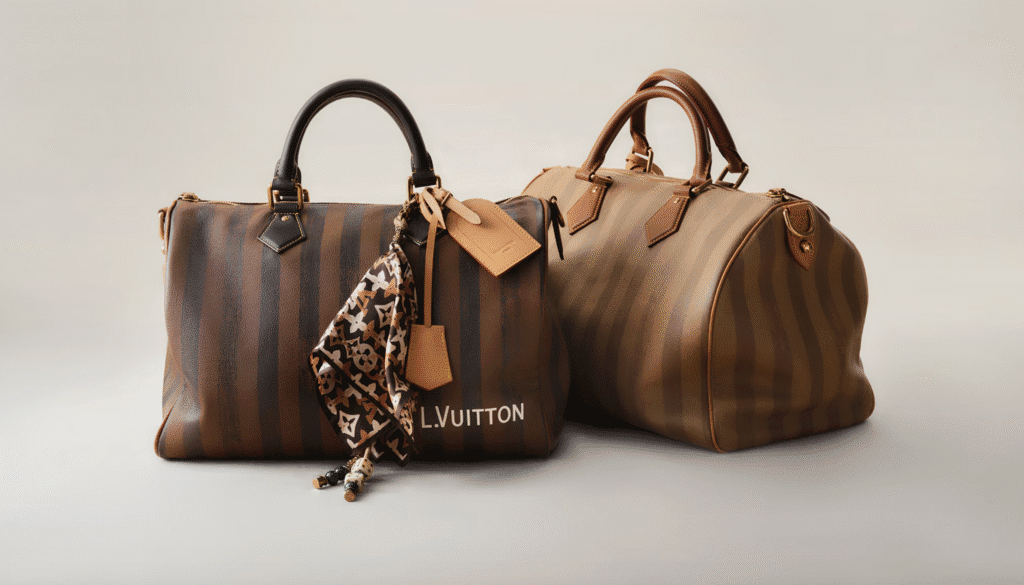
Count the monogram totes in a single subway car at rush hour.
Three. Five. Eight, on a crowded morning.
The feeling that arrives somewhere around the fifth one isn’t envy, and it isn’t distaste. It’s closer to a kind of quiet arithmetic your brain runs without asking permission: that pattern used to mean something specific, and I can’t quite locate when it stopped.
Run Louis Vuitton through BCI’s equation — BCI = (MT × TS^n) / (PL × ES⁻¹) — and that feeling has a precise structural source. But the more useful question this quarter isn’t what’s happening to the bag on the stranger’s shoulder. It’s what’s happening one level up, inside a conglomerate that has spent the last eighteen months leaning on this one brand harder than on any other asset it owns.
I. The Numbers LVMH’s Own CFO Volunteered
LVMH doesn’t disclose Louis Vuitton’s standalone financials. It never has. But on the Q1 2026 earnings call, held April 13, CFO Cécile Cabanis was asked directly whether Vuitton had performed above or below the Fashion & Leather Goods division average. Her answer, unprompted beyond the question itself: Vuitton was “more resilient than the average.” Dior was “improving quite a lot.” Loro Piana was “still growing double digits.” Rimowa was “outperforming the average.” The rest of the division’s brands — by elimination, Fendi, Celine, Givenchy, Loewe — were below it.
The division itself posted €9.25 billion in the quarter, down 9% on a reported basis, down 2% organically — a division-wide decline that Vuitton, on the CFO’s own account, did not fully share in.
Zoom out one more level, and the pattern holds a full year back: in the first half of 2025, Fashion & Leather Goods revenue fell 8% to €19.1 billion, but profit from recurring operations in the same division fell 18% — more than twice as fast as revenue.
Profit degrading faster than revenue in the same reporting line is the specific financial signature BCI treats as a leading indicator: not simply softer demand, but margin absorbing the cost of defending price architecture while volume slips. Somewhere inside that division-level number sits the answer to how much of that absorption Vuitton itself is doing, on behalf of brands that aren’t absorbing it as well.
II. What Happens When a CFO Volunteers a Defense Nobody Asked For
Later on the same April call, unprompted by any specific question about sentiment, Cabanis added something structurally more interesting than the resilience figures: “We really need not enter into a collective anxiety about Vuitton… it has always been able to nourish clientele and is continuing to do it with the best-in-class operating model… we have no worry about the growth at Vuitton.”
BCI didn’t choose the word “nourish.” LVMH’s own CFO did, to describe the one relationship this entire framework was built to measure — whether an asset is putting more into its ecosystem than it extracts, or the reverse.
A structural read doesn’t treat that sentence as concealment. It treats it as data. Executives don’t typically volunteer reassurance about the one brand nobody in the room raised a concern about. Analysts on that call, per the transcript, were probing regional exposure, tariff impact, watches and jewelry margins — nobody had directly challenged Vuitton’s health before Cabanis pre-empted the question.
That pre-emption is itself the signal worth logging: not proof that anything is wrong, but a quiet confirmation that, somewhere inside the building, someone is already tracking the very question this audit is asking.
III. The Mechanism That Makes the Resilience Possible
Vuitton’s relative outperformance isn’t accidental, nor is it evenly distributed across the brand’s product line. It runs on a structure that predates this earnings cycle by decades: a two-track architecture, monogram canvas at one end, exotic leathers and made-to-order pieces at the other.
The canvas tier — Speedy, Neverfull, the entry bags that produced the subway-car scene above — carries $PL$ that has been climbing toward saturation for years. Each new point of exposure, each wedding, each graduation, each duty-free counter, converts a little more of the pattern’s original meaning into simple recognition. That’s not a flaw in the business model.
It’s the model’s fuel supply: high-legibility, high-volume product generating the cash that funds the second track — rare leathers, made-to-order commissions, the invitation-only tier where $PL$ stays low and $MT$ stays genuinely intact.
The mechanism that has kept Vuitton “more resilient than the average” inside a declining division is very likely the same mechanism now being asked to do one more job it wasn’t originally built for: not just funding Vuitton’s own upper tier, but helping cushion a group whose other fashion houses aren’t generating the same surplus. $ES$ — the direction of energy flow between an asset and the system around it — was already running at full capacity internally.
This quarter’s numbers suggest it’s now being asked to nourish outward, past Vuitton’s own two tiers, into the division and the group.
That is not, on its own, a crisis. A cash engine funding a portfolio is precisely what a conglomerate structure is for. The open question is whether there’s a limit to how much can be drawn before the drain becomes visible inside Vuitton’s own $MT$ — not as a single bad quarter, but as the canvas tier’s saturation curve losing the counterweight the rare-leather tier was supposed to provide.
IV. The Test Arrives July 27
This is the part of the audit that isn’t settled yet, and it doesn’t need to be settled by narrative. LVMH reports first-half 2026 results on July 27 — five days from this note.
Two things to watch, both directly falsifiable, neither requiring a single subjective judgment call: whether Fashion & Leather Goods profit continues degrading faster than its revenue, the same pattern that showed up a year ago, or whether the gap finally closes.
And whether the CFO’s language on the call repeats the specific “more resilient than the average” framing for Vuitton alone, or whether the qualifier disappears — either because the rest of the division has caught up, which would be good news structurally, or because Vuitton’s own number has come down to meet them, which would not be.
BCI takes no position in advance of that data. What this audit can say is what would move the reading in either direction, stated before the number arrives rather than fitted to it afterward.
Three Ways to Have Noticed the Pattern First
If you’ve owned a canvas piece for years and recently felt a version of the subway-car moment yourself.
That instinct is accurate, not ungrateful. What you’re sensing is $PL$ saturation in the specific tier you bought into — a real, measurable condition — and it says nothing about whether the house’s rarer tier, the one you may never see, is experiencing the same thing.
If you hold LVMH stock on the belief that Vuitton alone justifies the position, regardless of what Fendi or Celine are doing.
That belief has real support in the data above — Vuitton has, by its own CFO’s account, been carrying more than its share. What’s worth tracking is whether “carrying more than its share” is a sustainable structural role or a temporary one with a cost that hasn’t shown up in a headline number yet.
If you read the CFO’s reassurance and immediately felt a version of the same question this audit is asking, without having the vocabulary for it.
That reflex — noticing that a defense arrived before an accusation — is exactly the kind of structural literacy this series was built to name. You don’t need the equation to have felt it. The equation gives it a shape you can track against the next earnings call, rather than relying on your memory of this one.
What This Series Set Out to Do, and Where It Leaves Off
This closes the four audits promised when this series began: Hermès as the control case for $MT$ held under genuine restraint. Ferrari as proof the framework generalizes past fashion into an asset priced on engineering.
Nike as the clearest documented case of $PL$ overshoot degrading a dominant $MT$ position, confirmed in the company’s own CEO’s words. And now Vuitton — not a verdict, but a live, dated test of whether a sovereign asset’s $ES$ stays nourishing when it’s asked to feed something larger than itself.
None of these were written to conclude that luxury is broken or that it’s fine. They were written to demonstrate that the gap between those two claims is measurable, before the filings settle it either way.
That work doesn’t end with a fourth report. It continues with whichever asset next sits at a threshold worth naming — audited the same way, on the same terms, whether the news is good or not.
This note is a structural read, not investment advice, and does not constitute a credit rating of LVMH Moët Hennessy Louis Vuitton SE, MC, or any security. BCI’s Structural Integrity Index is a proprietary analytical framework; all readings are subject to revision as new structural or financial data emerges.
Reassessment trigger: LVMH’s H1 2026 results, due July 27, 2026, specifically Fashion & Leather Goods profit-to-revenue divergence and any change in management’s brand-specific commentary on Vuitton. Governing reference: Hong Kong law.
For the framework this case is plotted against, see The BCI Matrix →.
If there’s another conglomerate-held asset where you suspect the strongest brand is quietly subsidizing the weaker ones, reply with the name. It goes in the queue.
— BCI Lab